

 The Atlantic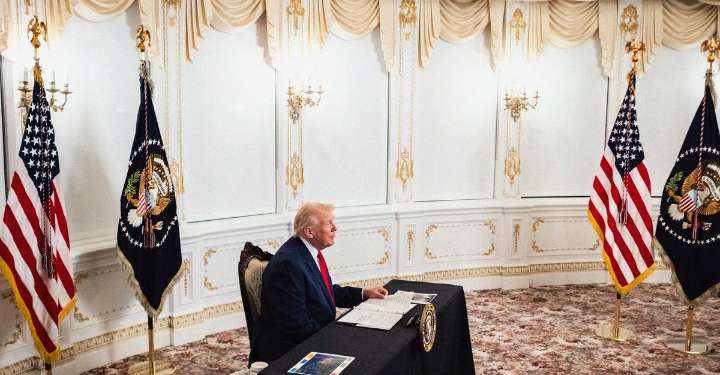
This is an edition of The Atlantic Daily, a newsletter that guides you through the biggest stories of the day, helps you discover new ideas, and recommends the best in culture. Sign up for it here.
For the past few weeks, President Donald Trump has seemed uncharacteristically passive. His own Republican Party bucked him on the release of files related to Jeffrey Epstein—in a movement partly led by Marjorie Taylor Greene, who once seemed like his staunchest apostle. His U.S. House gerrymandering campaign faltered under opposition from the GOP in deep-red Indiana, of all places. He even seemed awed by Zohran Mamdani, the mayor-elect of New York City, in an Oval Office meeting.
In recent days, though, the president has posted a series of angry tirades, apparently determined to reclaim his role driving the news.
During his first administration, Trump seemed to sow the most chaos after hours on Twitter, when his advisers had gone home for the night. His second administration may have no more “adults in the room,” yet the timing, during a holiday when he had more free time and fewer constraints, seems noteworthy. The stretch began with an awful event Wednesday night—the shooting of two West Virginia National Guard members, one fatal, in Washington, D.C., where Trump had deployed them. The suspect is Rahmanullah Lakanwal, an Afghan man who worked with the CIA during the American war in his country before seeking refuge in the United States and receiving asylum this past April.
In volatile situations, Trump can almost always be relied upon to choose the most inflammatory response, and this was no exception. When reporters asked him whether he’d attend the funeral of Sarah Beckstrom, the slain West Virginia Guard member, he said he hadn’t thought about it yet and pivoted to extolling his own electoral performance in the state. Later, the president posted a picture of people fleeing Kabul after the U.S. withdrawal (“the horrendous airlift from Afghanistan,” as he put it), and announced that he would “permanently pause migration from all Third World Countries to allow the U.S. system to fully recover, terminate all of the millions of Biden illegal admissions.” He also suggested stripping citizenship from immigrants and declared, “Only REVERSE MIGRATION can fully cure this situation.”
What any of this means in policy terms is unclear, including what specifically Trump means by “Third World,” a term that doesn’t hold practical meaning now that the Cold War distinction of First and Second World countries has dissolved. Mostly, it seems to be a cleaned-up label for what he has previously called “shithole countries”: those whose residents are not white. (The administration has also been working to cut off refugees, except for white South Africans, as well as Europeans who oppose immigration—except, presumably, in their own case.)
Trump was just warming up. On Thanksgiving Day, what began like a normal missive quickly went south. “A very Happy Thanksgiving salutation to all of our Great American Citizens and Patriots who have been so nice in allowing our Country to be divided, disrupted, carved up, murdered, beaten, mugged, and laughed at,” he wrote, before calling Minnesota Governor Tim Walz “seriously retarded” and attacking Representative Ilhan Omar, also of Minnesota, whom he described as “always wrapped in her swaddling hijab” and accused of entering the country illegally. (No evidence supports this.) Trump defended his use of the slur against Walz yesterday.
On Friday, Trump posted that he was “cancelling all Executive Orders” that President Joe Biden signed using an autopen, a remote-signature device that Trump has also employed. He threatened to try Biden for perjury if he claimed that he’d signed the documents. Again, the actual effects of such a statement are unclear. The most controversial application would be reverting Biden’s pardons and commutations, which Trump has alleged (without proof) that the former president was not aware of authorizing—though legal experts say these types of actions can’t be reversed.
If any grants of clemency are going to be reversed, a good candidate would be another one of Trump’s actions on Friday: the announcement of a pardon of Juan Orlando Hernández, the former president of Honduras. The floridly corrupt Hernández was sentenced to 45 years in prison last year for conspiring to import cocaine into the United States. Pardoning someone responsible for bringing literal tons of cocaine into the country makes no sense, especially given that Trump’s government is currently using likely illegal strikes to kill people it claims are trafficking small amounts in tiny boats. But Trump’s own experience as a convicted felon has apparently trained him to see convicted heads of state as victims of a political witch hunt. The president also recently commuted the sentence of David Gentile, a financier convicted in a $1.6 billion fraud scheme.
Saturday morning, he posted again, saying that “THE AIRSPACE ABOVE AND SURROUNDING VENEZUELA” should be considered “TO BE CLOSED IN ITS ENTIRETY.” Trump has no authority to unilaterally declare a no-fly zone over Venezuela, a sovereign nation with which the U.S. is not (yet!) at war. Even if such a thing were wise, the United States does not appear to be prepared to enforce it: Neither the White House nor the Pentagon has provided any more details or explanations that back up the statement. Never mind: Within 35 minutes, Trump had moved on to claiming to have driven drug prices down “500%, 600%, 700%, and more,” a mathematical impossibility.
In the most immediate sense, Trump’s rampage worked: He’s back in control of the news cycle. Whether that improves his political position, however, is an open question. Public racism and the use of slurs may be accepted in Trump’s base, and may even excite some of his supporters, but nothing suggests these behaviors will be well liked by the rest of the country, including independents who voted for him in 2024. On Friday, Gallup released a new poll showing Trump at his lowest approval of this term. The president can still seize the spotlight, but notoriety and popularity are not the same thing.
Related: • The Trump steamroller is broken. • A rogue nation on the high seas
Here are four new stories from The Atlantic: • The bubble-wrapped president • When Donald Trump fired David Rubenstein • Tom Nichols: Pete Hegseth needs to go—now. • The new German war machine
Today’s News • President Donald Trump is convening top advisers at the White House to discuss next steps on Venezuela. The meeting comes after the U.S. military deployed more than a dozen warships and 15,000 troops to the region under “Operation Southern Spear.” • Ukrainian President Volodymyr Zelensky is seeking European support as U.S. special envoy Steve Witkoff prepares to meet Russian President Vladimir Putin in Moscow tomorrow to discuss the revised U.S.-backed peace plan. But significant gaps remain as Ukraine presses for firm security guarantees and Russia shows little interest in making concessions. • A federal appeals court upheld a ruling disqualifying Alina Habba, Trump’s former personal lawyer, from serving as acting U.S. attorney in New Jersey.
Dispatches • The Wonder Reader: Isabel Fattal explores stories on what happens when people try to change their sleep habits.
Explore all of our newsletters here.
Evening Read
The People Outsourcing Their Thinking to AI
By Lila Shroff
Many people are becoming reliant on AI to navigate some of the most basic aspects of daily life. A colleague suggested that we might even call the most extreme users “LLeMmings”—yes, because they are always LLM-ing, but also because their near-constant AI use conjures images of cybernetic lemmings unable to act without guidance. For this set of compulsive users, AI has become a primary interface through which they interact with the world. The emails they write, the life decisions they make, and the questions that consume their mind all filter through AI first.

 Local News in New Jersey
 Raw Story
 AlterNet
 Associated Press US News
 Reuters US Domestic
 Reuters US Business
 Reuters US Top