

 The Atlantic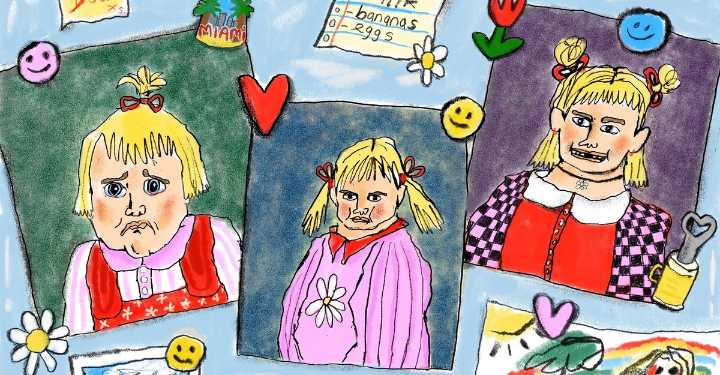
Just after my daughter turned 2, her day care initiated her into a rite of passage: picture day. I was a bit surprised—were we really doing this so early now?—but even so, I looked forward to seeing the proofs. The moment I opened them up, I snorted. The shots were endearing, sort of “somber Victorian child” meets “baby deer in headlights.” But then came the sticker shock: The cheapest package, for a few printouts, was $28; the most expensive, more than $100. How could a few goofy portraits cost so much?
Cracking angry jokes about school-photo prices has become something of a parental pastime. If families buy in, those with multiple children might spend upwards of several hundred dollars each year. Those with one kid could still have to fork over more than a grand by high-school graduation. In the packages I’ve looked at, if parents want just one photo to post on social media, it’ll cost them $65—the price of a single digital download, no physical prints included.
Of course, some parents don’t really care about the pictures. Others, looking to save a few bucks, share hacks online about how to get them for free. (It should be noted: Lots of these methods are illegal.) The portraits may be silly and stilted and worse than those taken with a phone—yet parents keep shelling out.
In many ways, the attachment to school photos is reflective of a broader nostalgic trend in photography. Polaroids, for example, remain popular, despite costing more than $2 a shot. Digital and film cameras have also made a comeback. Disposables are on the rise. Photos taken on these older styles of camera tend to look dated and a bit less polished, but that’s part of the appeal. As with school pictures, they might tap into a yearning for a time before smartphones allowed anyone to compulsively take as many photos as they wanted. The few shots you do get end up feeling unique.
Surely, that nostalgia drives some parents to buy. Shawn Smith, a professor of visual and critical studies at the School of the Art Institute in Chicago, also pointed out to me that picture day is a tradition that parents (and grandparents, and great-grandparents) are likely to have participated in when they were young. So parents may enjoy the thought of having photos of their own kids to add to their family’s school-photo lineage.
Although families are currently the target audience for school photos, initially the pictures weren’t for parents at all—they were for schools. The earliest images, which emerged in the latter half of the 19th century and were typically taken at colleges, tended to feature whole classes together, wearing matching clothing and arranged in neat rows. They were meant to project an image of the school as a successful, cohesive institution, Marianne Hirsch, a professor emerita at Columbia University and a co-author of School Photos in Liquid Time, told me. In the early 20th century, with the advent of portable photography and technological advances in printing, yearbooks became popular, and more schools started taking individual headshots, too, Kate Eichhorn, a professor at The New School and the author of School Yearbook, says. For parents, Hirsch told me, these pictures could be powerful, capturing “how your child is being seen in the world,” in contrast to “how you see your child.”
In the 1930s, some of the companies that still sell school portraits today formed—and over the ensuing decades, as in so many industries, a market full of smaller players consolidated into a market dominated by a few big players. Many of these companies offered schools a portion of profits, which tended to drive up prices. Now the largest school-photo provider, Lifetouch (owned by Shutterfly), photographs 30 million American schoolchildren each year—my daughter included.
For whatever reason, these photos consistently seem to capture the ridiculous: children with bangs askew, braces gleaming, smiles off-kilter. They’re a time capsule of kids’ most bizarre style choices (in my case, for my seventh-grade shot, a hot-pink GAP sweatshirt blending, chameleonlike, into a background of the same shade) and devotion to trends that the subjects will no doubt later find cringe. But the awkwardness is part of the charm, each forced pose and goofy expression a window into a child’s personality.
When it came time to make a decision about purchasing my daughter’s photos, I’ll admit: I gave in. I bought a basic package that first year and have continued to do so in the two years since. Call me a sucker, but that picture of her at age 2 caught what seemed like such a significant transition: her first year at day care, living her own life away from me. The photo may not be the best one I have of her, but I found something funny and touching in her inability (or unwillingness) to smile on command. She has lately learned to fall into line and flash a grin for the camera. But that old picture remains on my wall as a reminder of when she was too young to care, when her expression was undeniably her own.
When you buy a book using a link on this page, we receive a commission. Thank you for supporting The Atlantic.

 The Daily Sentinel
 People Human Interest
 POPSUGAR
 Lansing State Journal Sports
 Crooks and Liars
 MPR News Crime
 The List
 New York Magazine Intelligencer
 Foreign Policy
 NHL Arizona Coyotes