

 Reuters US Domestic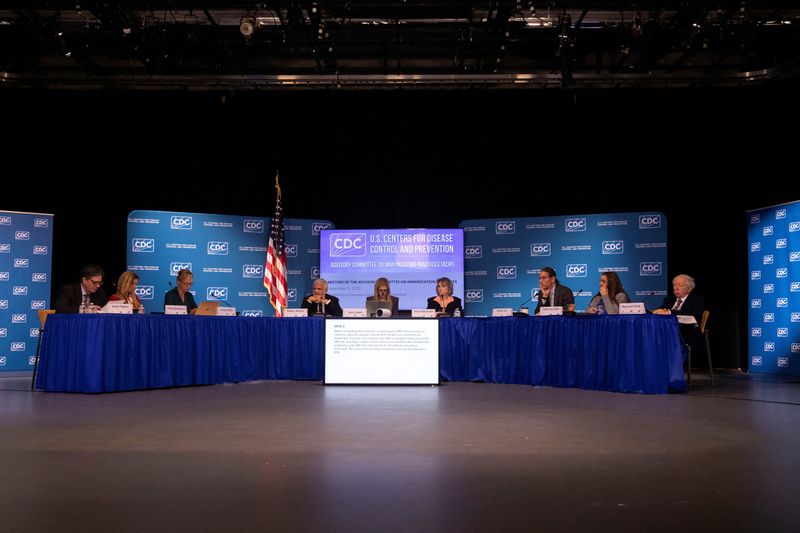
By Michael Erman, Julie Steenhuysen and Mariam Sunny
Dec 5 (Reuters) - A group of vaccine advisers on Friday scrapped a long-standing recommendation that all U.S. children receive the hepatitis B shot at birth, a major policy win for health secretary Robert F. Kennedy Jr that disease experts say will reverse decades of public health gains.
The committee voted to keep the birth dose only for infants whose mothers test positive for the virus, replacing the 1991 universal recommendation that has protected all children from hepatitis B infections, which can lead to serious liver disease.
For infants of mothers who test negative, the panel recommended that parents, in consultation with a healthcare provider, should decide when or if their child will begin the vaccine series. Under the scrapped recommendation, the birth dose is followed by two more vaccines, at 1 to 2 months and 6 to 18 months.
The committee recommended parents offer the first dose no sooner than two months of age and that parents test children for hepatitis B antibodies before deciding to give subsequent shots.
PUBLIC HEALTH EXPERTS DECRY MOVE
Public health experts decried the move, saying that a decision to shift to shared clinical decision-making would create obstacles to the use of vaccines, and that parents already have control over the care of their children.
Dr. William Schaffner, preventive medicine and infectious diseases specialist at Vanderbilt University Medical Center and a former committee member, said U.S. medical organizations have not supported the move.
"I think you’ll see the American Academy of Pediatrics, the American College of Obstetricians and Gynecologists and other major societies continue to recommend the vaccine at birth,” he said.
The committee advises the U.S. Centers for Disease Control and Prevention on which public health recommendations to adopt. The recommendations affect U.S. health insurance coverage and play a key role in assisting physicians who are choosing appropriate vaccines for patients.
KENNEDY HAS BEEN REMAKING VACCINE POLICY
Kennedy, who founded the anti-vaccine group Children's Health Defense, in June fired the previous 17 independent experts and replaced them with a group that largely supports his views as part of an effort to remake U.S. vaccine policy.
This is the most far reaching of the changes, which include dropping broad recommendations for the COVID vaccine, cutting funding for mRNA vaccines, and advising pregnant mothers against taking Tylenol saying, without scientific proof, that studies suggest a link to autism.
During the two-day meeting, two members of the committee argued vociferously against the change, saying there was no data to support it and that there were decades of information on the safety and efficacy of the vaccine.
"We will see more children and adolescents and adults infected with hepatitis B," said Joseph Hibbeln, a former National Institutes of Health official.
Many committee members argued that there was no data that showed the vaccine is safe and said that the U.S. was out of step with its peer countries.
"People should be very, very suspicious when people tell them that something is safe, especially a vaccine," said committee member Retsef Levi, a mathematician at the Massachusetts Institute of Technology.
The World Health Organization recommends all babies receive the hepatitis B vaccine as soon as possible after birth, followed by two or three doses of the shot at least four weeks apart. It says 95% of infected newborns will go on to develop chronic hepatitis.
(Reporting by Christy Santhosh, Mariam Sunny and Kamal Choudhury in Bengaluru, Michael Erman in New Jersey, Julie Steenhuysen in Chicago and Nancy Lapid in Phoenix; Editing by Caroline Humer, Bill Berkrot and Nick Zieminski)

 104FM WIKY
 WMBD-Radio
 Cheboygan Daily Tribune
 America News
 PHL17 Health
 Raw Story
 Associated Press US and World News Video
 RadarOnline
 1011 Now Sports