

 Reuters US Economy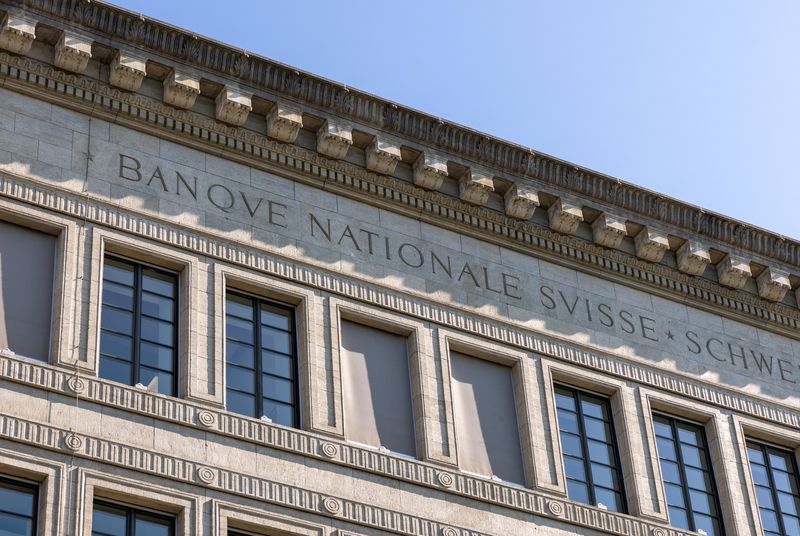
By Anant Chandak
BENGALURU, Dec 8 (Reuters) - The Swiss National Bank will keep its policy rate unchanged at zero for a second consecutive meeting on Thursday and through 2026 as inflation hovers near the bottom of its target range, according to most economists in a Reuters poll who said the risk of negative rates was low.
Despite inflation slowing to zero, the low end of the central bank's 0-2% target, all but two of 40 economists polled by Reuters in the December 3-8 period expect the SNB to leave its key interest rate on hold on December 11. Two economists predicted a cut to -0.25%.
The strong consensus partly results from Chairman Martin Schlegel's repeated assertion that the bar to cut rates below zero was high due to "undesirable side effects" and that the SNB would intervene in the foreign exchange market if necessary to ensure price stability.
The SNB last held rates below zero for a seven-year period up until mid-2022 in an attempt to mute deflationary pressure also made worse by a typically strong currency often sought by investors and traders during periods of market turmoil.
LOW RISK OF NEGATIVE POLICY RATE
A strong majority of economists polled, 21 of 25, who gave forecasts through the end of 2026 said the policy rate would stay on hold. Only five predicted a quarter-percentage-point reduction sometime next year, compared to seven in the survey in September.
The risk of the SNB adopting a negative policy rate was low, according to 14 of 17 economists, or more than 80%, who answered a separate question. That was a complete reversal from a poll taken in June when most said the risk was high. Only three economists in the latest poll said the risk of a negative policy rate was high.
"I'd still say inflation is going to pick up over the course of 2026 but stay within the SNB's target range. From that perspective, there is no need to further cut rates," said Florian Germanier, an economist at UBS, who added that there was a risk of monthly inflation briefly turning negative.
"The most likely trigger for ongoing deflationary pressure would be via the FX channel," Germanier added. "If you were to see phases of strong safe-haven flows, in these situations it's quite possible the Swiss franc temporarily appreciates against the euro. This move could be somewhat concerning for the SNB, and we wouldn't rule out the SNB to act, but prefer FX interventions."
The central bank stepped up its currency interventions in April to counter a safe-haven franc rally driven after the U.S. imposed sweeping tariffs on its trading partners, including Switzerland, which was hit with a 39% tariff, one of the most punitive rates imposed by Washington.
The currency has largely stabilised since then, rising 0.4% in November, allowing the central bank to ramp up its reserves to the highest level since February. A separate Reuters FX survey taken earlier this month predicted the franc would rise 0.8% against the euro to 0.945 in a year.
"We never expected negative rates ... but why consensus and markets are now expecting no more rate cuts has a lot to do also with the SNB's communication. They said they will tolerate some negative inflation readings in the short term as long as the medium-term inflation outlook is still solid," said Sophie Altermatt, an economist at Julius Baer.
Inflation was expected to average 0.2% this year and 0.4% the next, according to the poll. The Swiss economy is forecast to expand 1.2% in both years, up from 0.8% in 2024. The growth outlook was unchanged from September's survey despite the recent U.S. move to lower its tariffs on Swiss imports to 15%.
The central bank has said this move is not a "game changer" as only 4% of exports were affected by higher tariffs.
"We have growth holding up overall, and it's particularly driven by domestic consumption, so this part of the economy is doing fine," Altermatt said.
(Other stories from the Reuters global economic poll)
(Reporting by Anant Chandak; Polling by Debrah Gomes; Editing by Hari Kishan, Ross Finley and Paul Simao)

 Daily Voice
 Associated Press US News
 America News
 TODAY Video
 Reuters US Top
 Raw Story
 Cover Media
 NPR
NPR Reuters US Domestic