

 Cover Media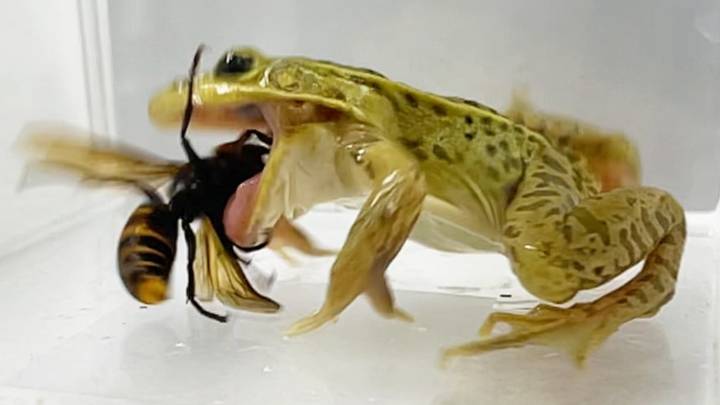
Japanese scientists have found a frog capable of shrugging off repeated 'murder hornet' stings.
The black-spotted pond frog, native to East Asia, was observed routinely preying on several species of hornet - insects armed with painful, potentially lethal stings.
For most people, even the sight of the stinger of an Asian giant hornet, also known as a 'murder hornet' is enough to inspire fear.
A single sting can cause intense pain, tissue damage and, in severe cases, life-threatening systemic reactions. Yet a handful of predators, including certain birds, spiders and amphibians, regularly consume adult hornets.
Until now, it has been unclear whether these animals withstand the venom or simply avoid being stung.
To explore whether the frogs evade or endure hornet stings, Dr Shinji Sugiura of Kobe University conducted controlled trials in which adult frogs were presented with workers from three hornet species: Vespa simillima, V. analis and the fearsome Asian giant hornet, V. mandarinia. Each frog was tested only once, with larger individuals paired with giant hornet workers of a matching size.
Reporting in the journal Ecosphere, Dr Sugiura found that the frogs actively attacked workers of all three species. Remarkably, 93%, 87% and 79% of the frogs successfully consumed V. simillima, V. analis and V. mandarinia respectively - often despite being stung inside the mouth or even in the eyes.
Previous research suggests that the pain caused by stinging insects does not always reflect the toxicity of their venom. Some species deliver agonising but non-lethal stings, while others inject highly toxic venom that causes surprisingly little pain.
The latest results suggest pond frogs may have evolved resistance to both the pain-inducing and harmful components of hornet venom, enabling them to hunt these formidable insects successfully.
Recordings from the experiments showed frogs swallowing hornets whole, even as the insects delivered repeated stings. The Asian giant hornet, which can cause severe pain and occasional fatalities associated with its sting - proved no safer than its smaller relatives.
Nearly 80% of the frogs paired with giant hornet workers managed to eat them. Frogs paired with the other species fared even better.
Researchers say the findings highlight the extraordinary digestive capabilities of many amphibians.
In previous studies, American toads have been shown to eat velvet ants - insects infamous for their painful stings - while a South American toad has been found to tolerate the venom of the Brazilian yellow scorpion. Poison dart frogs famously sequester toxins from their prey to create their own chemical defences.

 ABC News
 Law & Crime
 Newsday
 Associated Press Top News
 KCCI 8
 WRDW-TV News 12 Crime
 ABC30 Fresno World
 Newsweek Top
 TMZ Video