

 USA TODAY National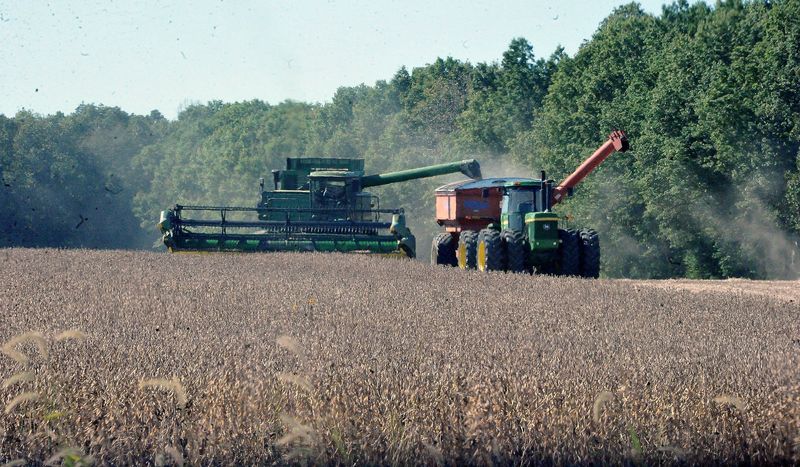
A few years ago, Wisconsin soybean farmer Doug Rebout was getting $14.50 a bushel for his crop. Now, amid a trade dispute with China and rising production costs driven by inflation, that price has plummeted to around $9.30.
Rebout's farm, which grows about 80,000 bushels of soybeans annually, is looking at a $400,000 economic loss due to the drop in prices, he told the Milwaukee Journal Sentinel, part of the USA TODAY Network.
Prior to President Donald Trump's announcement of a $12 billion assistance package for farmers, Rebout said that though financial aid would help farmers "weather the storm," many fear the economic uncertainty will linger. Some are worried about losing farms that have been in their families for generations.
"Right now, we're farming at losses because of these prices," Rebout said. "As farmers, we don't want to keep receiving bailouts. We want to get paid for our costs, be able to pay our own bills and make a little bit of money."
Soybean farmers were hit particularly hard when China, which has historically bought half of U.S. soybeans, retaliated against U.S. tariffs and turned to Brazil and Argentina instead. Meanwhile, the cost of labor, fertilizer, fuel, oil and seed rose.
Though aid is on the way, China has resumed purchasing American soybeans and some tariffs have eased, "farmers are really struggling," Angela Huffman, president and co-founder of the non-profit government watchdog Farm Action, told USA TODAY. The aid package is "welcome" and "needed desperately" to meet their immediate needs, but long-term structural change is essential, she said.
"The way we see it is these repeated bailouts are also a sign that the underlying system is broken," said Huffman, who runs an Ohio sheep farm.
Farmers try to cut costs as bankruptcies rise
Aaron Lehman, a central Iowa farmer and the Iowa Farmers Union board president, told the Des Moines Register, part of the USA TODAY Network, farmers are trying to cut costs wherever they can. Few are buying machinery and some are deferring equipment maintenance, trimming fertilizer, seed and chemical costs, and trying to renegotiate farmland rental agreements.
“Those needs don’t go away,” he said. “Sometimes, when the bill comes, it’s a lot bigger.”
Some have had to take off-farm jobs to stay afloat, Huffman said.
"They do what they can to scrape by, but a lot of them simply are not surviving," Huffman said. "It really is a crisis."
Huffman said dozens of farms were lost each day in recent years, prompting comparisons to the crisis of the 1980s that forced thousands of farmers into bankruptcy. Nearly half of farmers recently surveyed by the National Corn Growers Association think the country is on the brink of yet another farm crisis.
More than 180 farmers filed for bankruptcy protection in the first two quarters of 2025, nearly 60% more than this time last year, according to U.S. Bankruptcy Court filings. Arkansas led the nation with 19 farm bankruptcy filings, followed by Iowa, Georgia, California, and Nebraska.
Matt Deardeuff, an agricultural mediation specialist, told the Register, he's seen cases that are more complex, involve millions of dollars and often a dozen people apiece.
Fears for the future of agriculture
Trump said the aid package "will provide much needed certainty to farmers as they get this year’s harvest to market and look ahead to next year’s crops." But some uncertainty remains over whether China will be able to buy the millions of metric tons of soybeans the White House said it would over the next few years, given a glut of recent imports to that country, Reuters reported.
And if farmers are unable to sell all their soybeans, the crop will remain stored for the next year, creating an oversupply that could drag prices down even further. If that happens, "then our livelihood starts withering away a little bit," corn and soybean farmer Brian Warpup told The Indianapolis Star, part of the USA TODAY.
The Warren, Indiana, farmer doesn't know anyone who's lost their farm from the squeeze yet, but fears he will "if things don't change in the next year."
Rob Baker, a fifth-generation corn and soybean farmer in Leland, Mississippi, said the current crisis has felt like watching a "train wreck in slow motion." Baker said China has prepared for this moment over the years by "pumping money into Brazilian infrastructure."
With China's help, Brazil has doubled its output of soybeans in the last 15 years. If the expansion continues, Baker said he could see a day in five years when soybeans would not be a feasible, profitable crop for American farmers.
Baker, who is also the Mississippi representative on the board of directors for the American Soybean Association, told the Clarion-Ledger, part of the USA TODAY Network, in October that a bailout from Congress would be "a band-aid on a much larger problem."
"It will be greatly appreciated. Don't get me wrong," Baker said. "It will help people get through the year, but we need trade for the long term in order to be viable."
Contributing: Bart Jansen, USA TODAY; Reuters
This article originally appeared on USA TODAY: Desperate farmers say the 'system is broken' as bailout arrives
Reporting by N'dea Yancey-Bragg, Anna Kleiber, Donnelle Eller and Ross Reily, USA TODAY NETWORK / USA TODAY
USA TODAY Network via Reuters Connect

 Associated Press Top News
 Fairbanks Daily News-Miner
 NBC 7 San Diego Entertainmet
 WAND TV
 New York Daily News Snyde
 The Columbian Politics
 Raw Story
 Sweetwater Now
 The Daily Beast