

 Reuters US Economy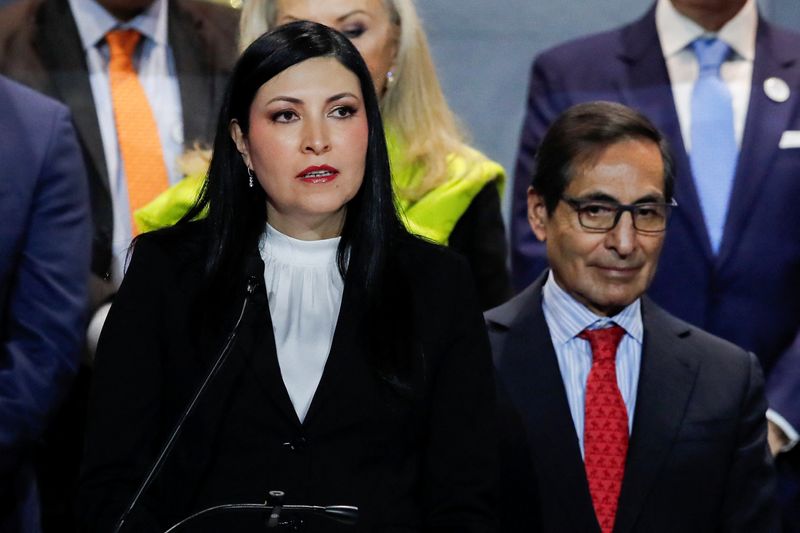
By Natalia Siniawski and Sarah Morland
MEXICO CITY, Dec 10 (Reuters) - Mexico's economy is solid and resilient, central bank chief Victoria Rodriguez said in a financial stability report on Wednesday, even as domestic financial risks increased.
The banking system of Latin America's second-largest economy continues to have levels of liquidity and capitalization above regulatory minimums, the central bank said, adding that stress tests confirmed banks could confront adverse situations.
"Everything increased compared to the last survey regarding internal financial risks," Rodriguez said in a presentation.
"The most notable was a deterioration in expectations for the national economy, followed by higher-than-expected inflation and the deterioration of public finances."
Last month, Mexico's central bank cut its economic growth forecast to near zero and raised its short-term inflation forecasts as the economy continues to navigate global trade uncertainty.
Regarding money laundering accusations against three Mexican financial institutions, Rodriguez said money laundering prevention mechanisms were being modernized and there were no signs of ripple effects in the wider banking system.
"These institutions have a low share of the financial system and do not pose a systemic risk to the stability of the system," she said.
INFLATION CONCERNS PERSIST
Rodriguez said that while inflation has broadly eased, challenges remain in bringing overall inflation to levels compatible with the central bank's target of 3% plus or minus one percentage point.
The central bank last month affirmed its forecast that inflation will hit that target by the second half of next year. But it slightly raised its forecasts for average annual core inflation for late 2025 and early 2026, as well as for general inflation in early 2026.
On Tuesday, official data showed that inflation accelerated to 3.8% in November, slightly above expectations.
But Rodriguez said policymakers will consider cutting the benchmark rate in their next policy decision, taking into account factors such as inflation.
The central bank has cut its benchmark rate by four percentage points since early last year. On November 6, its board made its eleventh consecutive cut, bringing the benchmark rate down 25 basis points to 7.25%, the lowest level since May 2022.
Deputy Governor Jonathan Heath, the only member to vote against the cuts for four straight meetings, has cast doubt on the reliability of the central bank's long-term inflation forecast.
In justifying the cuts, a majority of board members have cited falling headline inflation - now within one percentage point of the target - and economic weakness.
(Reporting by Natalia Siniawski and Sarah Morland; Editing by Paul Simao)

 The Motley Fool
 Benzinga
 Gainesville Sun
 Reuters US Business
 NPR
NPR Raw Story