

 ScienceAlert en Español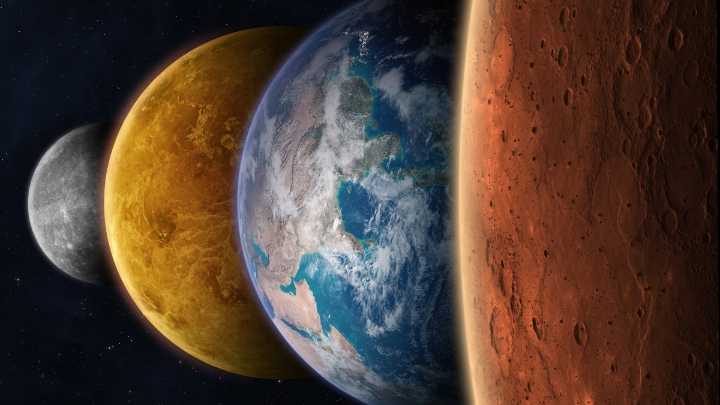
Earth's climate has swung between ice ages and warmer periods for millions of years, driven by subtle changes in our planet's orbit and axial tilt. These variations, known as Milankovitch cycles , occur because Earth doesn't orbit the Sun in isolation.
The gravitational pull of other planets constantly tugs at Earth, slowly altering its orbital path, the tilt of its axis, and the direction its poles point.
While astronomers have long known that Jupiter and Venus play important roles in these cycles, a detailed new analysis reveals that Mars too, despite being much smaller than the gas giants, exerts a surprisingly strong influence on Earth's climate rhythms.
Researchers led by Stephen Kane ran computer simulations that varied Mars's mass from zero to ten times its current value,
 NewsNation
 Reuters US Business
 NBC News NFL
 The Daily Beast
 Sweetwater Now