

 AlterNet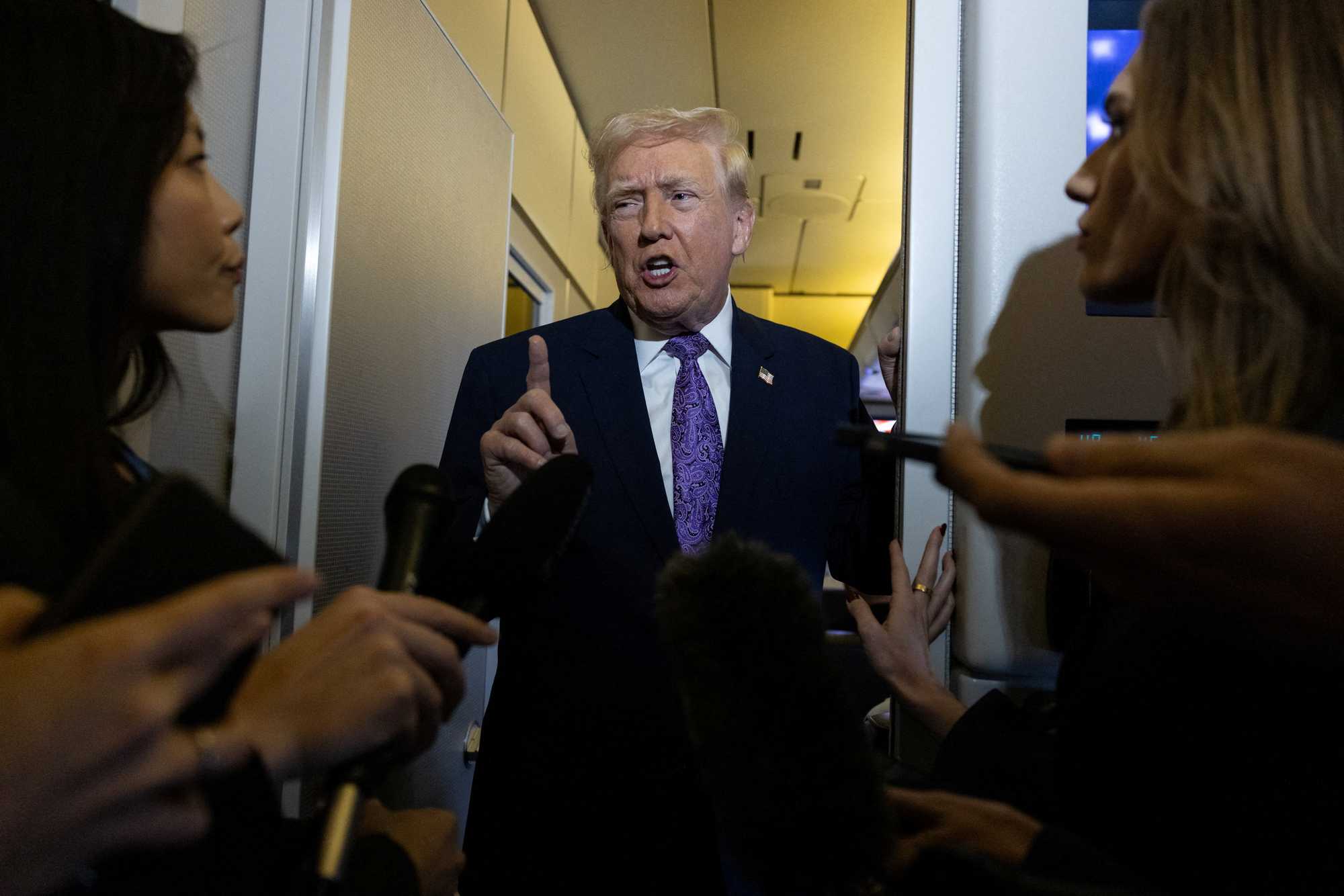
As the year comes to a close, 2025 looks like a turning point in the world’s fight against climate change. Most conspicuously, it was the year the U.S. abandoned the effort. The Trump administration pulled out of the 2015 Paris Agreement, which unites virtually all the world’s countries in a voluntary commitment to halt climate change. And for the first time in the 30-year history of the U.N.’s international climate talks, the U.S. did not send a delegation to the annual conference, COP30, which took place in Belém, Brazil.
This story was originally published by Grist. Sign up for Grist's weekly newsletter here.
The Trump administration’s assault on climate action has been far from symbolic. Over the summer, the president pressed his Republican majority in Congress to gut a Biden-era law that was projected to cut U.S. emissions by roughly a third compared to their peak, putting the country within reach of its Paris Agreement commitments. In the fall, Trump officials used hardball negotiating tactics to stall, if not outright derail, a relatively uncontroversial international plan to decarbonize the heavily polluting global shipping industry. And even though no other country has played a larger role in causing climate change, the U.S. under Trump has cut the vast majority of global climate aid funding, which is intended to help countries that are in the crosshairs of climate change despite doing virtually nothing to cause it.
It may come as no surprise, then, that other world leaders took barely veiled swipes at Trump at the COP30 climate talks last month. Christiana Figueres, a key architect of the 2015 Paris Agreement and a longtime Costa Rican diplomat, summed up a common sentiment.
“Ciao, bambino! You want to leave, leave,” she said before a crowd of reporters, using an Italian phrase that translates “bye-bye, little boy.”
These stark shifts in the U.S. position on climate change, which President Donald Trump has called a “hoax” and “con job,” are only the latest and most visible signs of a deeper shift underway. Historically, the U.S. and other wealthy, high-emitting nations have been cast as the primary drivers of climate action, both because of their outsize responsibility for the crisis and because of the greater resources at their disposal. Over the past decade, however, the hopes that developed countries will prioritize financing both the global energy transition and adaptation measures to protect the world’s most vulnerable countries have been dashed — in part by rightward lurches in domestic politics, external crises like Russia’s invasion of Ukraine, and revolts by wealthy-country voters over cost-of-living concerns.
The resulting message to developing countries has been unmistakable: Help is not on the way.
In the vacuum left behind, a different engine of global climate action has emerged, one not political or diplomatic but industrial. A growing marketplace of green technologies — primarily solar, wind, and batteries — has made the adoption of renewable energy far faster and more cost-effective than almost anyone predicted. The world has dramatically exceeded expectations for solar power generation in particular, producing roughly 8 times more last year than in 2015, when the Paris Agreement was signed.
China is largely responsible for the breakneck pace of clean energy growth. It now produces about 60 percent of the world’s wind turbines and 80 percent of solar panels. In the first half of 2025, the country added more than twice as much new solar capacity as the rest of the world combined. As a result of these Chinese-led global energy market changes and other countries’ Paris Agreement pledges, the world is now on a path to see 2.3 to 2.5 degrees Celsius (4.1 to 4.5 degrees Fahrenheit) of warming by 2100, compared to preindustrial temperatures, far lower than the roughly 5 degrees C (9 degrees F) projections expected just 10 years ago.
These policies can be viewed as a symbol of global cooperation on climate change, but for Chinese leadership, the motivation is primarily economic. That, experts say, may be why they’re working. China’s policies are driving much of the rest of the world’s renewable energy growth. As the cost of solar panels and wind turbines drops year over year, it is enabling other countries, especially in the Global South, to choose cleaner sources of electricity over fossil fuels — and also to purchase some of the world’s cheapest mass-produced electric vehicles. Pakistan, Indonesia, Vietnam, Saudi Arabia, and Malaysia are all expected to see massive increases in solar deployment in the next few years, thanks to their partnerships with Chinese firms.
“China is going to, over time, create a new narrative and be a much more important driver for global climate action,” said Li Shuo, director of the China climate hub at the Asia Society Policy Institute. Shuo said that the politics-and-rhetoric-driven approach to solving climate change favored by wealthy countries has proved unreliable and largely failed. In its place, a Chinese-style approach that aligns countries’ economic agendas with decarbonization will prove to be more successful, he predicted.
Meanwhile, many countries have begun reorganizing their diplomatic and economic relationships in ways that no longer assume American leadership. That shift accelerated this year in part due to Trump’s decisions to withdraw from the Paris Agreement, to impose tariffs on U.S. allies, and more broadly, to slink away into self-imposed isolation. European countries facing punishing tariffs have looked to deepen trade relationships with China, Japan, and other Asian countries. The EU’s new carbon border tax, which applies levies to imports from outside the bloc, will take effect in January. The move was once expected to trigger conflict between the EU and U.S., but is now proceeding without outright support — or strong opposition — from the Trump administration.
African countries, too, are asserting leadership. The continent hosted its own climate summit earlier this year, pledging to raise $50 billion to promote at least 1,000 locally led solutions in energy, agriculture, water, transport, and resilience by 2030. “The continent has moved the conversation from crisis to opportunity, from aid to investment, and from external prescription to African-led,” said Mahamoud Ali Youssouf, chairperson of the African Union Commission. “We have embraced the powerful truth [that] Africa is not a passive recipient of climate solutions, but the actor and architect of these solutions.”
The U.S. void has also allowed China to throw more weight around in international climate negotiations. Although Chinese leadership remained cautious and reserved in the negotiation halls in Belém, the country pushed its agenda on one issue in particular: trade. Since China has invested heavily in renewable energy technology, tariffs on its products could hinder not only its own economic growth but also the world’s energy transition. As a result the final agreement at COP30, which like all other United Nations climate agreements is ultimately non-binding, included language stipulating that unilateral trade measures like tariffs “should not constitute a means of arbitrary or unjustifiable discrimination or a disguised restriction on international trade.”
Calling out tariffs on the first page of the final decision at COP30 would not have been possible if negotiators for the United States had been present, according to Shuo. “China was able to force this issue on the agenda,” he said.
But Shuo added that other countries are still feeling the gravitational pull of U.S. policies, even as the Trump administration sat out climate talks this year. In Belém last month, the United States’ opposition to the International Maritime Organization’s carbon framework influenced conversations about structuring rules for decarbonizing the shipping industry. And knowing that the U.S. wouldn’t contribute to aid funds shaped climate finance agreements.
In the years to come, though, those pressures may very well fade. As the world pivots in response to a U.S. absence, it may find it has more to gain than expected.
This article originally appeared in Grist at https://grist.org/international/2025-trump-climate-change-paris-agreement-china/.
Grist is a nonprofit, independent media organization dedicated to telling stories of climate solutions and a just future. Learn more at Grist.org

 Reuters US Domestic
 Raw Story
 WFMJ-TV
 People Top Story