

 The Atlantic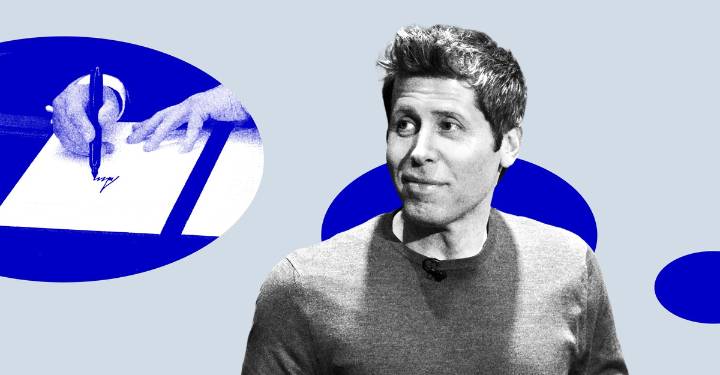
OpenAI turned 10 yesterday, and President Donald Trump incidentally gave the company a very special birthday gift: a sweeping executive order aiming to dismantle and preempt many state-level regulations of artificial intelligence. “There’s only going to be one winner here, and it’s probably going to be the U.S. or China,” Trump said in a press conference announcing the order. And for the United States to win, “we have to be unified. China is unified.”
Almost all of the AI industry’s biggest players have been pushing for this move. OpenAI has been asking all year for the Trump administration to preempt state-level AI regulations, which the company believes would be burdensome in various ways; Microsoft, Google, Meta, Nvidia, and the major venture-capital firm Andreessen Horowitz have made similar requests. These firms and Trump have the same argument: Having to comply with dozens or hundreds of state regulations would be onerous, slowing the pace of AI development and putting China at an advantage. (OpenAI, which has a business partnership with The Atlantic, did not respond to a request for comment.)
Yesterday’s executive order instructs a set of federal agencies to identify state AI regulations that could be deemed cumbersome and then take action against those policies, such as through litigation or conditioning federal funding on not enacting or enforcing the policies. The order also takes aim at state laws that “embed ideological bias within models,” part of both Trump’s and Silicon Valley’s siege on equity and antidiscrimination initiatives. Many civil-society groups and elected Democrats have already come out against the order, calling it, for instance, a “terrible idea” that will allow AI firms and products to run amok.
Trump’s order will surely meet legal resistance from tech-regulation advocates, states, and federal lawmakers, who may argue that it bypasses state laws and usurps congressional authority. Nevertheless, it is a culmination of a trend that has been clear since Trump’s inauguration, when the leaders of Google, Meta, Apple, Amazon, and Tesla stood on the dais just behind him. This administration and Silicon Valley are broadly aligned in their technological accelerationism.
There are bountiful examples. The day after Trump was sworn in, he hosted OpenAI CEO Sam Altman at the White House and announced Stargate, a $500 billion AI-infrastructure venture. Elon Musk, of course, spearheaded the White House’s early attempts to remake the federal government through the Department of Government Efficiency. Trump has heaped praise on Altman, Nvidia CEO Jensen Huang, Apple CEO Tim Cook, and others. And the Trump administration’s AI Action Plan, released this summer, made clear the president’s intention to essentially grant the chatbot industry’s every wish.
There is not perfect harmony between Trump’s coalition and Silicon Valley. Throughout the second Trump administration, there have been disagreements over skilled immigration, which many MAGA supporters resist and tech CEOs support. One of OpenAI’s major competitors, Anthropic, has vocally opposed attempts to undermine state AI regulations, as have some Senate Republicans. (Dario Amodei, Anthropic’s CEO, also likened Trump to a “feudal warlord” in a preelection Facebook post endorsing Kamala Harris.) But these arguments haven’t been a real obstacle to the Trump-AI accord. The president has recently said that allowing skilled immigrants to train U.S. workers in high-tech factories “is MAGA,” much of the AI industry has labored to prove that its chatbots are not “woke,” and major tech firms are among the donors for Trump’s White House ballroom.
Of course, Trump is mercurial, his views influenced by whomever he’s happened to meet with most recently. Also this week, the Trump administration lifted export controls banning the sale of one of Nvidia’s most advanced AI chips to China. This has been a subject of heated debate among tech executives, even hawkish ones: OpenAI, Anthropic, and other AI firms have argued against selling advanced American AI chips to China, as a way to maintain the nation’s technological edge. Nvidia, which stands to profit handsomely from the rule change, has argued that making Chinese firms dependent on American technology is the best way to establish dominance. And as Nvidia caught Trump’s ear on this issue over the past several months, Altman has softened his position, saying that export controls may not provide an effective form of leverage over China’s AI industry after all.
Meanwhile, there is an emerging populist sentiment against AI—for the threat it poses to some users (through chatbot-associated delusions, for instance, or through AI-generated child porn), as well as for spiking electricity prices due to data-center development. Despite the AI industry’s push to build a huge number of data centers, and repeated requests to deregulate that construction, Trump’s executive order notably includes a carve-out for state laws regarding “data center infrastructure”—which means that the federal government “would not force communities to host data centers they don’t want,” as the White House AI adviser David Sacks explained on X. Many people have started to ask reasonable questions about the circular AI economy, which has yet to produce profits for companies such as OpenAI. Trump, meanwhile, is in his last term, and the MAGA coalition is arguably fracturing. The preemption itself may not even be all that popular among MAGA Republicans, many of whom have previously been highly critical of such a policy. And executive orders are famously impermanent. Perhaps the AI industry’s best bet is to secure everything available while it can.

 AlterNet
 CNN Video
 Raw Story
 Associated Press US News
 Mediaite