

 The Atlantic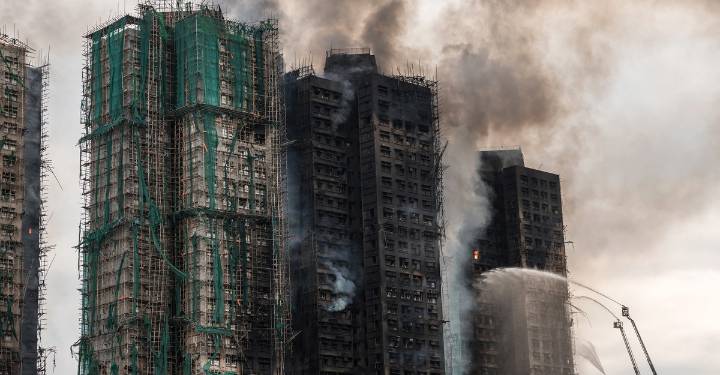
The world’s deadliest residential fire in more than four decades was still burning up a block of Hong Kong apartment buildings when pundits settled on a culprit: bamboo. Surely, the bamboo scaffolding that had surrounded the Wang Fuk Court towers explained how the flames tore through the complex so quickly. “There can be only one outcome,” the Independent declared. “The bamboo has to go.” But the disaster, which killed at least 160 people, reflects problems much more profound than the choice of scaffolding.
These problems first took root as China prepared to assume control of Hong Kong from Britain, in 1997. Concerned that the transition would scare off foreign investors, Chinese leaders tried to woo real-estate tycoons and other business elites by giving them key roles overseeing the city’s future governance. Beijing then propped up this new ruling class as a bulwark against efforts to further democratize the territory.
The nexus between Hong Kong’s government and Big Business gave rise to a real-estate market that served a select few elites rather than most residents. Limited supply and soaring costs precipitated a decades-long housing crisis, consigning roughly 220,000 Hong Kongers to subdivided apartments sometimes called “coffin homes,” which can be smaller than a parking space. Meanwhile, the market delivered increasing returns to the city’s elite. Of the 16 Hong Kongers listed in the Bloomberg Billionaires Index, seven owe their family fortune to real estate.
As the housing market generated greater wealth for Hong Kong’s tycoons, the construction and real-estate industries achieved growing immunity from regulatory oversight. Government deference, in turn, allowed corruption and corner cutting to proliferate, particularly among contractors involved in renovating the city’s limited housing stock.
This dynamic most likely played a key role in last month’s fire. As part of a government investigation, Hong Kong authorities allege that the construction company that had been renovating the Wang Fuk Court towers for the past year used unsafe materials. The government’s concern centered not on the much-maligned bamboo but on flammable window cladding made of polystyrene foam as well as exterior netting that wasn’t fire-retardant. The investigation also revealed evidence that contractors might have deactivated some fire alarms during the renovation work and given false information to officials. (Neither the construction company, which has a history of safety violations, nor a consultancy involved in the renovation process has publicly commented on the investigation.)
But the city’s authorities, too, bear responsibility. They seem to have disregarded warning signs about the multimillion-dollar renovation. Jason Poon Chuk-hung, a construction executive turned industry watchdog, told me that a small group of residents emailed city officials twice in September to say they were worried that the safety netting covering the towers posed a fire hazard. Officials ignored their concerns, Poon said.
Then, in mid-October, a large fire erupted in the city’s business district, burning for hours and injuring four people. Poon described this as a warning from the gods about the conflagration to come. Just over a month later, a few minutes before 3 p.m. on November 26, flames started rising up Block F of Wang Fuk Court. Soon they spread from building to building, engulfing most of the complex.
As part of a criminal investigation into the fire, police have arrested some 20 people, including construction-firm bosses and fire-equipment contractors. John Lee, Hong Kong’s chief executive, has initiated a judge-led review of the towers’ renovation process. At the same time, however, authorities have stifled public expressions of discontent and suppressed civic-led solutions, arresting three people for alleged sedition. One of the three is reportedly a university student who circulated a petition calling for the government to ensure housing is provided for displaced residents and to determine the role that regulatory neglect may have played in the fire, among other demands. An online version of the document garnered more than 10,000 signatures; then it vanished.
That wasn’t the only evidence that dissent has been silenced. On one university campus, plastic barricades were erected to cover up signs posted on the student union’s message board calling for justice for the victims. (The university suspended the union soon after.) In addition, at least two people who gave interviews to foreign media about the fire later indicated on social media that the government had pressured them to stop. Last weekend, authorities summoned international media organizations to an in-person meeting with national-security officials, who issued an apparent threat about spreading “false information and smear campaigns,” according to a statement from the Office for Safeguarding National Security. “Don’t say that you weren’t warned,” an official who declined to give his name told the assembled journalists.
Beijing’s recent repression echoes its response to past tragedies. In 1989, the public came out to mourn the death of a reformist leader, Hu Yaobang; these gatherings evolved into the Tiananmen Square protest, which China brutally crushed. For Beijing, the episode offered a lesson: Mourning can lead to resistance. Its fear of history repeating may explain the absurd accusation from a Hong Kong spokesperson that recent gatherings of mourners at memorial sites were really the work of “foreign” forces seeking to “maliciously smear” the government’s relief efforts. Beijing’s national-security office in Hong Kong claimed that bad actors were using the tragedy to revive “protest memories” of the city’s 2019 pro-democracy demonstrations and possibly launch “another ‘color revolution.’”
On Sunday, as some Hong Kongers were still mourning, the city held a “patriots only” legislative election. Only 32 percent of the city voted, in part because the regime had pre-vetted the candidates, purging older lawmakers from the ballots who had connections to the system that predated Beijing’s clampdown of the city in 2020. A new guard of über-nationalists took their place.
Both the election and the response to the fire suggest that Hong Kong is moving ever closer to Beijing’s system of repression, which meets crises not with transparency and reform but with threats and censorship. A more authoritarian order almost certainly won’t tackle the deep-seated problems—corporate misconduct, regulatory neglect, and an unaccountable elite—that seem to have contributed to last month’s tragedy and that raise the risk of future ones.
Hong Kong’s leaders might decide to get rid of bamboo scaffolding. But don’t expect that to fix anything.

 New York Post
 ABC News
 WEIS Radio
 Associated Press Top News
 Raw Story
 CNN
CNN Massillon Independent
 AlterNet