

 The Atlantic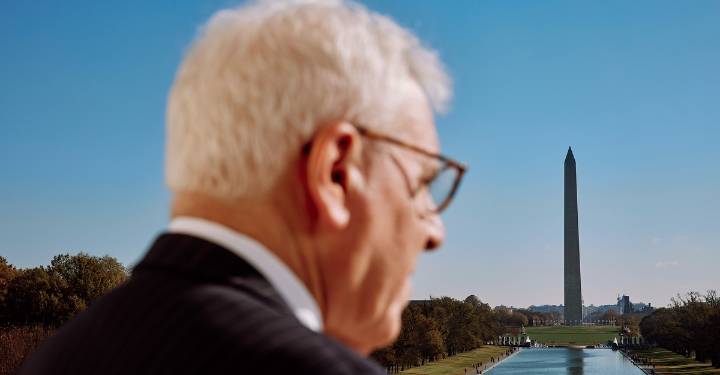
David Rubenstein, the billionaire investor and philanthropist, sat at a handsome marble table in a handsome conference room in one of the many handsome offices of the Carlyle Group, the global investment firm he co-founded, discussing a bit of personal unpleasantness.
Several weeks earlier, Donald Trump had fired him as the chair of the John F. Kennedy Center for the Performing Arts. Rubenstein chairs many elite institutions, but the Kennedy Center might be seen as the capstone of his résumé. Explaining his decision, Trump had posted on Truth Social that Rubenstein did not “share our Vision for a Golden Age in Arts and Culture.” The president announced that the “amazing” new chair of the center would instead be one “DONALD J. TRUMP.”
Rubenstein, who is not accustomed to being fired, at first deflected my questions with gin-dry self-deprecation: “I’m the first person to be fired by a president and succeeded by one.” But the firing stung. Rubenstein has, for decades, converted his extraordinary wealth into soft power, cultivating an ostensibly apolitical brand. He calls himself a practitioner of “patriotic philanthropy,” with a stated mission to remind Americans of their heritage and history in service of a strengthened democracy. As part of that mission, Rubenstein has given away more than $1 billion. His name is stamped all over the Washington region.
The homestead of Thomas Jefferson has a David M. Rubenstein Visitor Center; George Washington’s estate benefited from a $10 million donation to its library. Rubenstein gave the National Museum of African American History and Culture $10 million, along with a copy of the Emancipation Proclamation that is displayed in the David M. Rubenstein History Galleries. He donated in excess of $100 million to the Kennedy Center, where he oversaw construction of a large annex. When the giant pandas Bao Li and Qing Bao arrived at the National Zoo last autumn by airplane from Chengdu, China, they set out to explore their new digs: the David M. Rubenstein Family Giant Panda Habitat. When an earthquake damaged the Washington Monument in 2011, Rubenstein kicked in $10 million to help pay for repairs.
I first interviewed Rubenstein months before the 2024 presidential election. Back then, he was confident that he could manage his relationship with Trump if he were to win, as Rubenstein had after Trump’s 2016 victory. The two men regarded each other as friends—sort of. In 2014, he interviewed Trump onstage at the Economic Club of Washington (“When David calls, I say yes,” Trump told the crowd). The Trump of 2025, however, is a different fellow than the Trump of 2017. Institutions and norms at least tolerated by previous Republican presidents exert no hold on him, nor do the genteel mechanisms of soft power that have run Washington for years. The mere existence of a complex of arts, history, and the old Washington establishment itself, all sitting somewhere just outside the official D.C. bureaucracy, seems to rankle Trump—especially when the leaders of those organizations decline to declare fealty to him. All of this set Rubenstein on an unintended collision course with Trump.
Besides, Rubenstein told me, only half joking, having “a billion dollars is not what it used to be.” Rubenstein did not, in the fashion of Bill Gates, build a paradigm-shifting computer-operating system. He did not, as Steve Jobs did, create an artful, culture-shifting technology firm. Nor did he, like Jeff Bezos, construct a consumer behemoth. The lifework of private-equity barons offers less social utility. They accelerate the financialization of the world economy, boost the performance of public pension funds and college endowments, and produce fabled wealth for themselves and the exceedingly comfortable. Along the way, their work can sometimes make life measurably more painful for families on the lower end of the income scale.
Rubenstein, who is 76, has studied the actuarial tables and knows his end is an approaching train. He remains a co-chair of Carlyle and still travels the world raising money and speaking at lavish investor conferences. He drinks neither alcohol nor coffee, plays no golf, and harbors no desire to retire and work on a meditative memoir.
Trump has signaled—much as Vladimir Putin did to his own oligarchs—that even the wealthiest would be wise to bend a knee. He’s given the comfortable class a clear look at what he can do to those who refuse to do his bidding. Trump has batted around Federal Reserve Chair Jerome Powell—a former Carlyle partner and a friend of Rubenstein—like a piñata for refusing to cut interest rates. Trump has ended federal contributions to PBS—Rubenstein is one of its largest individual donors, and has hosted two shows on the network. Trump has similarly attacked the Smithsonian, complaining that it’s out of control and overly focused on “how bad Slavery was.” He has demanded a “comprehensive internal review” of its exhibitions.
If there was a single way to describe Trump’s institutional targets in the first year of his second term, it might be “David Rubenstein’s Rolodex.” What had long been Rubenstein’s instrument of immense power and influence is now a liability.
[From the June 2025 issue: Ashley Parker and Michael Scherer on Donald Trump’s return to power]
Rubenstein grew up in what he calls a “Jewish ghetto” in deeply segregated 1950s Baltimore. He recalls thinking as a child that everyone in the world was Jewish; he told me he was 13 when he realized that there were far more goyim. His grandfather had come to the United States in the early 20th century at the age of 10, fleeing anti-Semitic pogroms in Ukraine. (An Ellis Island clerk, he says, changed the family surname from Rubensplash to Rubenstein.) His father served in World War II and worked as a postal clerk, and his mother worked in a dress shop.
I asked if Rubenstein discerned an arc to his life, some hint or premonition of great riches and influence to come. He wagged his head no. He was not a good athlete; he peaked in Little League. He insisted to me that he wasn’t intellectually gifted, despite having skipped eighth grade and graduated high school at 16 years old. And socially, well, “I wouldn’t say that the girls in the Baltimore Jewish community were just saying … ‘This guy is so handsome, charming. He’s wealthy. He’s going to be famous.’ No, there was none of that.” He gave me a palms-up shrug and made rare eye contact: “It was a tortoise-and-the-hare thing.”
Rubenstein did, however, feel a skin-afire urgency for a life that was more than the post office. He wanted to break out, though how and to what end was a mystery. He attended Duke University, where he studied political science, followed by law school on full scholarship at the University of Chicago. Rubenstein landed at the white-shoe law firm Paul, Weiss, Rifkind, Wharton & Garrison, where he worked for two years in the ’70s. There he befriended Ted Sorensen, a former speechwriter for President John F. Kennedy, who became his mentor.
Being a lawyer was not, he came to realize, his calling. He told Sorensen several times that he yearned to work in politics and public policy. His ambition was not workaday; Rubenstein said that he had the White House in his sights. Sorensen made a few phone calls, and at age 25, Rubenstein became chief counsel to the charismatic senator Birch Bayh, a Democrat from Indiana. Bayh entered the 1976 Democratic presidential primary with high hopes but flamed out, laid low in part by his support for abortion rights. Rubenstein dialed Sorenson again. “Well, do you have any more candidates that I might work for?” he asked. Sorensen put Rubenstein in touch with a powerful lobbyist, who in turn connected him with a southern Democratic presidential candidate who needed staff. Rubenstein signed on. “I didn’t know Carter from a hole in the wall,” he told me. “I can’t say I had a compelling desire to work for Jimmy Carter.”
Yet he would serve as a top deputy to Carter’s domestic-policy adviser, Stuart Eizenstat. He described himself as “not qualified, not experienced, but eager,” and he grew accustomed to walking into the Oval Office and talking with Carter. (He recalled that the president was “very smart,” a taskmaster who hated split infinitives. “No one would say he had a great sense of humor,” he said.) Rubenstein was a bundle of nervous energy. He ate out of White House vending machines and walked about hollow-eyed from lack of sleep.

 Raw Story
 Reuters US Domestic
 Newsweek Top
 AlterNet
 AmoMama