

 AFP Top News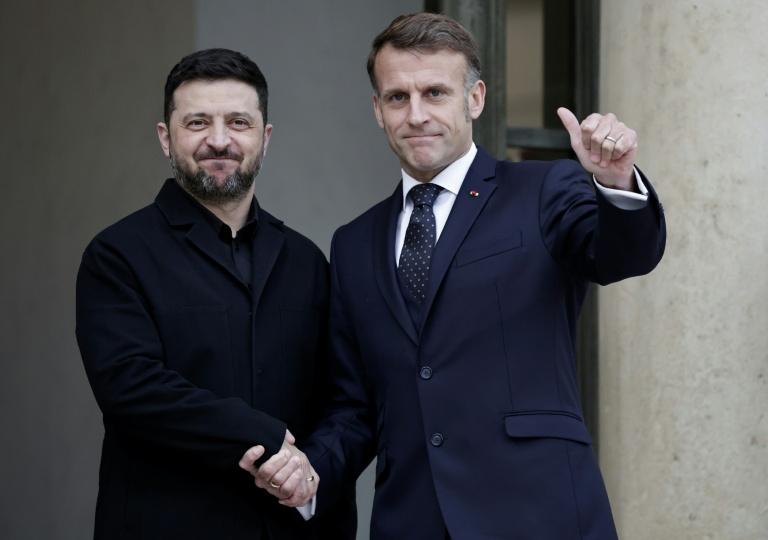
Ukrainian President Volodymyr Zelensky said Monday he expected to discuss "key issues" with Donald Trump as the American-led push to end Russia's war on Ukraine accelerated, with the US president's envoy heading to Moscow.
Ukraine's negotiator Rustem Umerov said "significant progress" had been achieved in two days of talks with US officials on Trump's plan to end the war, even though more work was needed on "challenging" issues.
The comments came as US envoy Steve Witkoff was due to meet Russian President Vladimir Putin in Moscow on Tuesday, the latest in a flurry of diplomacy to halt the conflict.
Zelensky spoke after meeting French President Emmanuel Macron in Paris as he sounded out European allies on Washington's blueprint, which was drafted without input from Kyiv or Europe and has been criticised as too close a reflection of Moscow's maximalist demands.
More than three-and-a-half years into Russia's full-scale invasion, an AFP analysis of data from the US-based Institute for the Study of War (ISW) showed the Russian army last month made its biggest advance in Ukraine since November 2024.
The situation for Kyiv has been further complicated by a corruption scandal that has rocked Zelensky's inner circle and forced the dismissal last week of his top negotiator and chief of staff, Andriy Yermak.
"We are expecting a conversation with the president of the United States on key issues that are quite challenging," said Zelensky.
He said Russia had stepped up missile and drone strikes on his country to "break" the will of Ukrainians.
"This is serious pressure, not only psychological but also physical pressure on our population," Zelensky said.
Macron said the current moment "could be decisive for the future of peace in Ukraine and security in Europe".
US and Ukrainian negotiators held hours of what both sides called "productive" talks in Florida on Sunday, with Trump declaring on Air Force One "there's a good chance we can make a deal".
Zelensky insisted Russia should not receive any concession that "it could consider as a reward for this war."
"The aggressor must pay for the aggression," he said.
Witkoff earlier held a new meeting in Florida with Umerov, Ukraine's security council secretary.
"We managed to achieve significant progress, although certain issues require further refinement," said Umerov.
Sources said Zelensky "expects to see Umerov in Ireland" during a visit on Tuesday to hear a detailed report on the Florida talks.
Zelensky and Macron also spoke by telephone to Witkoff and Umerov in Florida, the Elysee said, while Zelensky's talks in Paris also included phone conversations with other European leaders, including British Prime Minister Keir Starmer.
- 'Highest' pressure -
Washington's initial 28-point proposal to halt the war would have seen Kyiv withdraw from territory it still controls in its eastern Donetsk region and the United States de facto recognise the Donetsk, Crimea and Lugansk regions as Russian.
After talks in Geneva, the United States updated the original blueprint, but the current contents remain unclear.
EU foreign policy chief Kaja Kallas expressed concern over the planned Putin-Witkoff meeting, saying she feared "all the pressure will be put on the weaker side, because that is the easier way to stop this war when Ukraine surrenders."
German Chancellor Friedrich Merz meanwhile said there should be no "dictated peace" for Ukraine.
Macron emphasised that "there is currently no finalised plan on the territorial issues, strictly speaking. It can only be finalised by President Zelensky."
He also hailed new US sanctions on the Russian energy industry as a "game changer", saying that in the next weeks he expected pressure on the sector to be "the highest since the beginning of the war".
- Biggest advance in a year -
The diplomatic push comes as the war -- which has killed tens of thousands of civilians and military personnel and displaced millions of Ukrainians -- shows no sign of easing.
A Russian missile attack killed four people and wounded nearly two dozen others on Monday in the central Ukrainian city of Dnipro, the regional governor said.
During November, Russia captured 701 square kilometres (270 square miles), the second-largest territorial advance of the war after that of November 2024 -- not taking into account the initial months of the invasion, when the front line was highly mobile, the AFP analysis of data from the ISW showed.
By the end of November, the Russian army controlled, fully or partially, 19.3 percent of Ukrainian territory, according to the analysis of data from the ISW, which works with the Critical Threats Project.
burs-sjw/as/jhb

 Associated Press Top News
 Breitbart News
 New York Post
 America News
 CNN
CNN CBS News
 Reuters US Economy
 Detroit News
 RadarOnline