

 Cover Media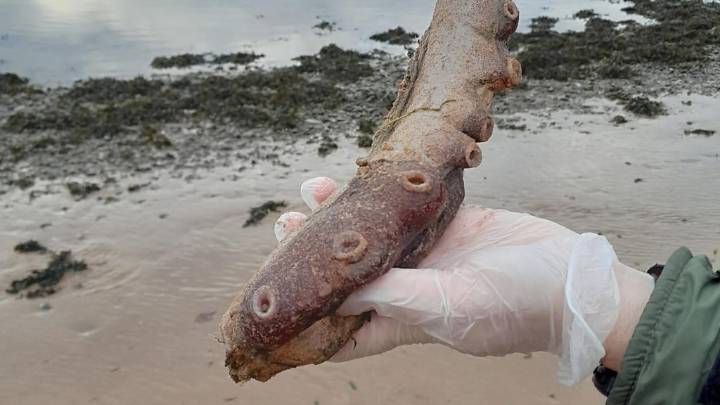
Scottish conservationists were left mystified when strange tentacles began washing up on an Aberdeenshire beach - until the sea monster's remains were identified as those of a rare species of octopus.
A member of the public discovered the arms, complete with rows of suckers, at Forvie National Nature Reserve near Collieston on Sunday and alerted staff. Reserve workers later recovered sections of the remains after the next high tide.
Photographs and measurements taken at the scene quickly ruled out any of Scotland's native coastal octopus species. Early speculation considered whether the remains might belong to a large squid, including the possibility of an Architeuthis (Giant Squid) - a species with a few historic records in Aberdeenshire, including Newburgh in 1998.
However, the absence of the characteristic "toothed" suckers seen in the Giant Squid suggested otherwise.
The surprised marine specialists, who say the species - a seven-arm octopus or septopus - is rarely encountered and usually lives hundreds of metres below the surface.
The species, one of the world's largest, does in fact possess eight arms. In males, however, one of the arms functions as a reproductive organ and is detached during mating.
Dr Lauren Smith, a marine biologist with the East Grampian Coastal Partnership, said: "This is an extraordinary find, to have a deep-water species like Haliphron atlanticus appear here is incredibly rare and offers a valuable opportunity for further study. The recovered remains have been frozen down for further study, with some potentially being preserved as museum specimens."
The mystery was eventually solved by specialists at the University of Aberdeen and New Zealand-based marine biologist Dr Steve O'Shea, who confirmed the remains belonged to Haliphron atlanticus, aka the seven-arm octopus.
This has, however, created another mystery, one likely to remain unsolved - how on Earth the remains of this monstrous deep-sea dweller made it to a Scottish beach.

 KNAU
KNAU Santa Maria Times Safety
 Omak Okanogan County Chronicle
 AlterNet
 The Hollywood Gossip
 Associated Press US News
 America News