

 USA TODAY National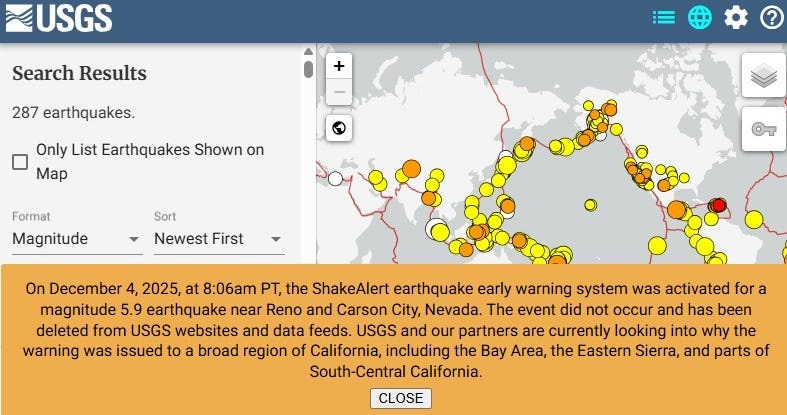
A shake alert went out over the U.S. Geological Survey's early warning system on Dec. 4, warning that a 5.9 earthquake near Carson City in western Nevada could produce heavy shaking in the region.
But moments later, the survey announced the alert, which was sent to people as far west as San Francisco, was a false alarm.
A message was quickly posted across the top of its website, saying the “ShakeAlert Earthquake Early Warning" system was incorrect in alerting for an earthquake near Carson City, Nevada at 8:09 a.m. local time.
The "earthquake" was deleted from the agency's map and the correction went out over USGS social media channels. The message stated: “The event did not occur and has been deleted from USGS websites and data feeds. The USGS is working to understand the cause of the false alert.”
"There was no M5.9 earthquake near Carson City, NV, this morning," the USGS told USA TODAY in an email. "We are currently looking into why the warning was issued. We'll provide more information when we learn more."
Among the questions USGS and its partners are trying to answer is why the warning "was issued to a broad region of California, including the Bay Area, the Eastern Sierra, and parts of South-Central California," the agency stated.
Although false alerts from the system have been rare, earthquakes are not rare in Nevada. It's the third most seismically active state in the nation, behind California and Alaska.
The false alert was confirmed by Kyren Bogolub, seismologist at the University of Nevada, Reno Seismological Laboratory.
"This was an errant earthquake warning sent out by the USGS’s ShakeAlert system," Bogolub told the Reno Gazette-Journal, a member of the USA TODAY Network. "We are awaiting more information from the USGS."
What is the ShakeAlert EEW system?
The USGS early warning system is used across California, Oregon and Washington to send alerts when strong shaking is expected immediately. The USGS monitors and reports earthquakes and assesses impacts and hazards, and is part of a larger National Earthquake Hazards Reduction Program, a four-agency partnership established by Congress.
“The ShakeAlert system has accurately detected the majority of earthquakes that have occurred within the operational region since completing the public rollout,” the survey concluded in an August 2024 review.
The review evaluated the warning system’s performance during 95 earthquakes of 4.5 magnitude or higher that the system had alerted between October 2019 and August 2023. Although the system had concluded seven of those earthquakes were false, they were actually real earthquakes, the USGS review found.
Only one of the 95 events wasn’t a real earthquake, the USGS report stated. The review did find issues with reporting of earthquakes that were along the edges of the seismic network, which runs along the California and Nevada state line.
Dayton, where the alert stated the quake was occurring, is roughly 20 miles east of the state line. USA TODAY has reached out to the USGS for further comment.
Shaking not uncommon in Nevada
While Thursday's report was a false alarm, Nevada has seen major earthquakes and is striped with fault lines.
Since January 1990, seismic monitoring has reported 80 earthquakes of a 4.5 magnitude or greater in Nevada, according to the USGS database. Thousands of lesser magnitude earthquakes have been reported in the region.
The largest of the earthquakes since 1990 was a 6.5 on May 15, 2020, centered in Monte Cristo. A 6.1 occurred on September 12, 1994. A 5.7 magnitude quake was reported on Dec. 9, 2024 and a 4.8 was reported on Nov. 29, 2025.
However, of those 80 reported events since 1990, 10 were actually nuclear explosions picked up by seismic monitoring, according to USGS data. All of those were reported between June 1990 and February 1992, and all were more than 200 miles to the south of Carson City.
Real earthquakes occurred elsewhere on Dec. 4
Nearly three dozen earthquakes had been reported around the world by 2:30 on Dec. 4, including a 5.8 magnitude quake near Tumxuk, China, a 5.5 earthquake in the Pacific-Antarctic region. Three 5.3 magnitude earthquakes were reported, one each in the Kermadec Islands region, Fiji and El Morro, Mexico.
See the map below for seismic activity detected on Dec. 4.
Reactions to the false alert
At the Roadrunner Café in Dayton, a regular customer said he heard there was an earthquake on the radio, but that came as a surprise to Shannon Mackey, manager of the family-run breakfast spot. It was breakfast as usual at the cafe, and Mackey said she hadn't felt any shaking.
Lyon County officials, where the false alert said the event was centered, sent a notice to its residents. "We are awaiting additional information and will share when it is available," the county stated. "There is currently no hazard to the public."
Both the quake alert and the retraction quickly attracted widespread interest and theories on social media.
"Needless to say, this has led to rampant speculation on social media about how this could have happened," Alan Gerard, a retired federal meteorologist, wrote in a blog post on Substack on Dec. 4. We "definitely need to understand more about what happened today before jumping to conclusions," Gerard wrote.
However, he added events like this one reinforce "the importance of federal science in the safety and livelihoods of the citizens of our country."
This story was updated to add new information.
This article originally appeared on USA TODAY: Nevada earthquakes? USGS sent an alert but here's what really happened
Reporting by Dinah Voyles Pulver, Christopher Cann, Siobhan McAndrew, Brett McGinness and Carly Sauvageau, USA TODAY / USA TODAY
USA TODAY Network via Reuters Connect

 New York Post
 News Radio 690 KTSM
 The Weather Channel
 The Daily Sentinel
 AccuWeather Severe Weather
 Mediaite
 AlterNet
 Raw Story
 Space.com
 WCPO 9
 CNN
CNN Essentiallysports Football