

 The Conversation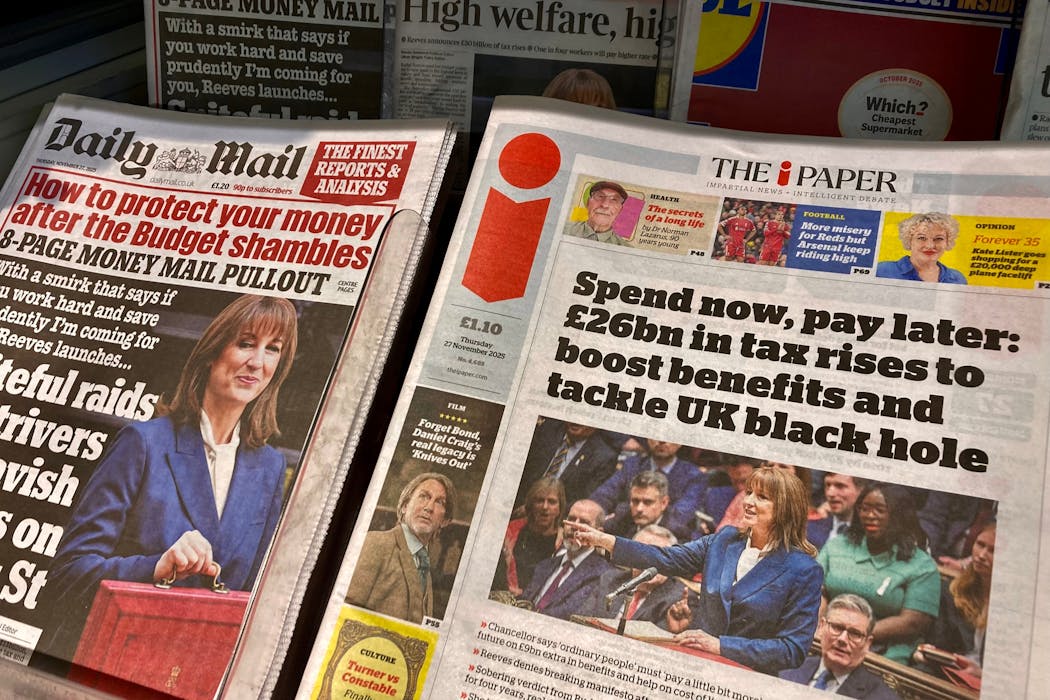
Headlines about tax in the UK being at an all-time high abounded after the autumn budget. The current overall tax take, at 35% of GDP, is indeed a historic high for the country. And the measures announced in the budget will take it to 38% by the end of the parliament.
Yet, contrary to what some might have you believe, it is only high by British standards.
If the UK wants a decent welfare system in the coming years, it’s time to start doing things differently. But this can’t just mean raising taxes to meet the growing demands of an ageing society.
The structure of the UK’s tax system must be fixed before politicians even think about further rises, since its complexity and distortions hold back investment, productivity and long-term growth.
In 2023, the tax take as a percentage of GDP was 35.3%, slightly above the overall average for the 38 countries in the Organisation for Economic Cooperation and Development (OECD). This placed the UK 18th on the list and almost two percentage points lower than the average of other European members.
But even the new figure of 38% does not take the UK anywhere near the top. It matches Germany, but remains significantly lower than the tax take in France, Italy, Belgium and the Nordic countries, where the tax share exceeds 40% of GDP.
The UK has a deep productivity problem. Real wage growth has collapsed from being third best among OECD countries before 2008 to 16th afterwards. Without a recovery, the country will not be able to maintain levels of public provision, let alone reboot the health and public support systems.
The welfare system certainly needs a reboot, as our latest research shows. In health, the NHS is grappling with some of the longest waiting lists on record as well as delivering comparatively poor results. At the same time, thousands of people are stuck in hospital due to the lack of affordable social care.
Social housing is increasingly out of reach for those who need it: the gains of the right to buy policy of the 1980s have been confined to those who bought their council houses, while the costs of that mass sell-off are borne by the state and today’s poor in the form of housing shortages and high rents.
Perhaps most damning of all, child poverty has risen steadily since 2010 and is now among the highest in the OECD.

The pressures on the system will only grow. The ageing population is dramatically increasing pension costs and the demand for social care. Advances in healthcare, while holding out the prospect of longer and higher-quality lives, are also extending the years that people can live with chronic conditions. This is particularly true among lower-income groups who often lack the means to maintain their health.
The health and social care sector is one where the real cost of delivery is rising, so the UK will need to increase the resources flowing into it just to stand still.
The pension triple lock is continuing to exacerbate the pressure on public finances. Meanwhile, precarious and low-paid employment means millions of people still rely on in-work benefits. And the post-COVID surge in health and disability-related personal independence payments (Pip) shows no signs of abating.
What kind of country does the UK want to be?
We see two feasible paths forward to fix the distortions in the tax system while ensuring that those who need the welfare state don’t fall through the widening cracks. But here’s the rub. Both would be extremely difficult politically.
First, the UK could accept that a universal welfare state is not affordable, and radically reshape and target it. The question is whether the public would tolerate deeper means-testing, for instance, which might represent a genuine reshaping of the welfare state.
The founder of the welfare state, William Beveridge, understood that his system required not only technical solutions but a compelling narrative about social solidarity where all citizens bought into its core principles.
Second, the country could engage in a genuinely open debate on the cost of and willingness to pay for welfare services. It could then fix the tax system to fund comprehensive welfare provision, moving toward European-style social insurance systems.
The UK spends just over 11% of GDP on welfare, placing it near the OECD average and well below Nordic countries and France. The fact that overall tax take of 35% rising to 38% is a historic high makes any conversation about taxation hard – perhaps impossible.
But UK outcomes compared to those of its neighbours who spend more should be food for thought. The answer cannot be in stealth taxes.
The budget mainly just walked a path of continuation from a long period of piecemeal reforms that may not achieve what they are intended to. It raised revenue primarily through fiscal drag (the freezing of tax thresholds so that rising pay pushes more people into higher brackets).
It did remove the regressive limit on universal credit or tax credits for larger families, but in the main it continues to follow a path of least political resistance. This is likely to result in the gradual emergence of a two-tier system where those who can afford it increasingly opt for private healthcare, private housing and private education.
Given how much resistance the government is facing even now, perhaps the path of least resistance is the only option available. But perhaps a braver conversation is possible – one that spells out the human tragedy of under-investing in welfare and the economic problems of continuing with the current UK tax structure.
What won’t work is pretending these choices don’t exist. The UK has neither the benefits of low taxes nor the welfare outcomes of its higher-tax neighbours. It’s time to redesign the tax and welfare system for the century we’re in.
This article is republished from The Conversation, a nonprofit, independent news organization bringing you facts and trustworthy analysis to help you make sense of our complex world. It was written by: Christopher Adam, University of Oxford and İrem Güçeri, University of Oxford
Read more:
- Why the £18 million for playgrounds in the budget is so important – and how it should be spent
- Why Rachel Reeves chose a ‘smorgasbord’ of tax tweaks – and the risks involved in that approach
- The three spectres hanging over Rachel Reeves’ make-or-break budget
The authors do not work for, consult, own shares in or receive funding from any company or organisation that would benefit from this article, and have disclosed no relevant affiliations beyond their academic appointment.


 TownTimes news.com
 Associated Press Top News
 Oscoda Press
 Arizona Republic
 AlterNet
 The radio station 99.5 The Apple
 Cheboygan Daily Tribune
 Arizona's Family
 The Daily Beast