

 The Conversation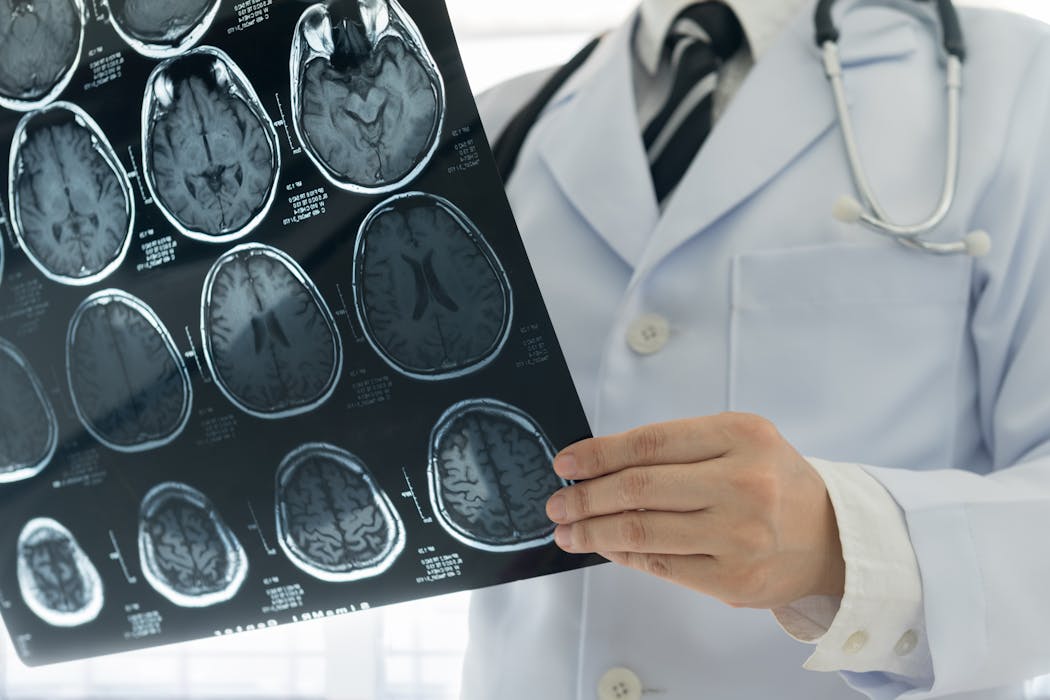
If you watched Kim Kardashian’s latest health update and felt a jolt at the phrase “holes on the brain”, you were not alone. It is a term that sounds catastrophic. Yet on the type of scan she had, a hole does not mean missing tissue. It signals a region working at a lower level because it is receiving less blood and oxygen, often due to age, stress or other long-term influences. That distinction matters. True holes look very different and usually arise from severe disease.
In footage from her reality show The Kardashians, her doctor points out “holes” on a brain scan, describing them as areas of “low activity”. These were found on a single-photon emission tomography, or Spect, scan, which uses a small dose of radioactive tracer and a specialised camera to show how well different parts of the brain are functioning. Around the same time she was also diagnosed with a brain aneurysm, discovered during an MRI scan. The aneurysm is a structural weakness in a blood vessel and is unrelated to the low-activity patches seen on Spect.
These “holes” or “dents” are actually a normal part of brain ageing and can appear in people in their early forties. They do not appear in everyone, but they are a common feature of midlife scans and reflect reduced blood flow in small, localised areas. In typical ageing the brain loses about five percent of its volume each decade, even without any disease.
Lower activity on Spect can arise for many reasons. Chronic stress, for example, has been shown to cause macroscopic changes in the brain, including changes in the connections between neurons. Although there is no evidence or suggestion that drug use plays any role in Kardashian’s results, recreational drugs can also affect brain function. Cocaine dependency has been shown to accelerate tissue loss at almost twice the rate of normal ageing, and opioids, marijuana, methamphetamine, heroin and ketamine have each been linked to measurable structural changes.
True brain holes
True holes involve actual tissue loss, and the causes are far more serious. Fortunately, many are extremely rare. Some infections destroy local brain tissue, including Creutzfeldt-Jakob disease, where a misfolded protein triggers widespread cell death, creating a sponge-like appearance. Bacterial infections such as staphylococcus and streptococcus can form abscesses that leave visible cavities. These infections usually spread from the ears, teeth or sinuses and are medical emergencies.
Another rare cause is taenia solium, a pork tapeworm whose larvae can lodge in the brain and deprive tissue of nutrients. The parasite drew attention after Robert F. Kennedy Jr, now the US health secretary, revealed that he had experienced brain fog and memory problems due to an infection.
Read more: Did a worm really eat part of Robert F. Kennedy Jr.'s brain?
More common causes include stroke, which affects 12 million people globally each year. In both ischaemic and haemorrhagic stroke, blood supply is disrupted and tissue can die, leaving holes or areas of atrophy on scans. Atrophy means tissue has shrunk because cells have died or stopped functioning.
Conditions that disrupt fluid balance can also damage tissue. In hydrocephalus, cerebrospinal fluid builds up inside the brain’s cavities, compressing and sometimes killing surrounding tissue if untreated. The fluid normally carries nutrients and removes waste, so blocked flow can be devastating.
Aggressive brain tumours such as glioblastoma can produce cavities by crowding out healthy tissue and diverting nearby blood supply towards tumour cells. Treatments such as radiation therapy can also damage healthy neurons because radiation is toxic to brain cells.
Read more: Glioblastoma: why immunotherapy may offer hope for brain cancer patients
These conditions often produce swelling called oedema, including vasogenic oedema, where leaking fluid increases pressure on surrounding tissue. Traumatic brain injury is another cause of progressive tissue loss. Repeated head impacts can lead to chronic traumatic encephalopathy, seen in some athletes involved in American football, rugby and boxing as well as mixed martial arts. Recent research shows one in three American football players believe they have symptoms linked to CTE.
These conditions differ sharply from the findings on Kardashian’s Spect scan. True holes reflect actual tissue loss and usually come with clear neurological symptoms. Treatment cannot always reverse the damage, but early medical assessment can manage symptoms and slow further decline. Anyone experiencing memory loss, difficulty concentrating or problems with movement should seek medical advice.
The low-activity patches seen on Kardashian’s scan fall into a different category. They do not reflect missing tissue and are not expected to cause symptoms. Instead, they are typically associated with ageing, stress or long-term lifestyle factors rather than disease.
This article is republished from The Conversation, a nonprofit, independent news organization bringing you facts and trustworthy analysis to help you make sense of our complex world. It was written by: Adam Taylor, Lancaster University
Read more:
- Why neglecting your brain health can make it harder to achieve physical goals
- Bacteria in your mouth may hold clues to your brain health and dementia risk – new study
- Poor sleep may make your brain age faster – new study
Adam Taylor does not work for, consult, own shares in or receive funding from any company or organisation that would benefit from this article, and has disclosed no relevant affiliations beyond their academic appointment.


 Martinsburg Journal
 New York Post
 People Top Story
 The Atlantic
 The Post and Courier
 San Bernardino Sun
 Psychology Today
 New York Post Health
 VICE
VICE Honolulu Star-Advertiser Traffic
 CNN Business