

 Reuters US Politics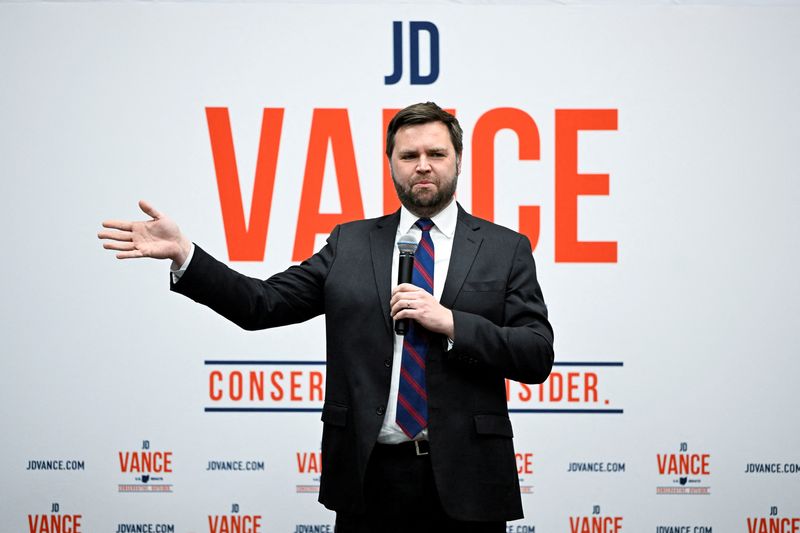
By John Kruzel and Andrew Chung
WASHINGTON, Dec 9 (Reuters) - A divided U.S. Supreme Court wrestled on Tuesday with a Republican-led bid to strike down on free speech grounds federal limits on spending by political parties in coordination with candidates in a case involving Vice President JD Vance.
At least four of the six conservative justices appeared sympathetic toward the challenge during more than two hours of argument in the case, with the court's three liberal members seeming inclined to preserve the spending limits. The dispute centers on whether federal limits on coordinated campaign spending violate the U.S. Constitution's First Amendment protection against government abridgment of freedom of speech.
Republican President Donald Trump's administration argued in support of the challenge, which was brought by plaintiffs including two Republican committees as well as his vice president Vance, who was running for the U.S. Senate in Ohio when the case began, and Republican former congressman Steve Chabot.
The challengers appealed a lower court's ruling that upheld restrictions on the amount of money parties can spend on campaigns with input from candidates they support, a type of political spending called coordinated party expenditures. The case is being argued with the November 2026 midterm elections looming, as Republicans seek to maintain control of both chambers of Congress.
Conservative Justice Brett Kavanaugh voiced concern that "the combination of campaign finance laws and this court's decisions over the years have together reduced the power of political parties as compared to outside groups, with negative effects on our constitutional democracy."
The Federal Election Campaign Act of 1971 regulates fundraising and spending in U.S. elections by limiting the amount that can be spent on a candidate. Defenders of this law credit it with guarding against corruption.
Under the law, spending by a political party to advocate for or against a candidate that is not coordinated with a candidate's campaign is considered an "independent expenditure" not subject to amount limits. Contributions coordinated between a party and a campaign, however, are restricted.
Liberal Justice Sonia Sotomayor lamented the court's prior rulings against campaign finance limits, noting the large sums now collected by presidential candidates for both main parties.
"Once we take off coordinated expenditure limits, then what's left? What's left is nothing. No control whatsoever," Sotomayor said.
Sotomayor appeared to invoke billionaire Tesla CEO Elon Musk, the world's richest person, who spent nearly $300 million to back Trump's presidential campaign and other Republicans last year and quickly emerged as a powerful force in the White House after Trump was elected. Musk led the so-called Department of Government Efficiency before leaving the administration in May.
"You mean to suggest that the fact that one major donor to the current president - the most major donor to the current president - got a very lucrative job immediately upon election from the new administration does not give the appearance of quid pro quo?" Sotomayor asked Noel Francisco, a lawyer for the Republican challengers.
"I have a hard time thinking that his salary that he drew from the federal government was an effective, quid pro quo bribery, which may be why nobody has even remotely suggested that," Francisco responded, using a Latin term meaning a favor for a favor.
"Maybe not the salary, but certainly, the lucrative government contracts might be," Sotomayor said.
Sarah Harris, arguing for Trump's administration, said the true motivation behind the federal spending limits at issue was not an attempt to prevent quid pro quo corruption, but rather an "impermissible judgment" by Congress and incumbent candidates to prescribe "how much money should be spent in a particular election context."
The Supreme Court in several rulings since 2010 has chipped away at campaign finance laws. These include rulings striking down federal limits on independent expenditures and the overall amount an individual could spend on federal political contributions as First Amendment violations.
THE MOOTNESS ARGUMENT
Because the Federal Election Commission under Trump has declined to defend the restriction at issue, the court appointed lawyer Roman Martinez to do so. It also permitted three Democratic groups to defend the lower court's decision.
Martinez sought to discredit the claim by the challengers that coordinated expenditures were purely about political speech.
"It's paying the electric bill, it's paying the florist bill, it's paying the pizza bill, it's any expense that the campaign wants," Martinez said.
Martinez said the case should be thrown out because Vance has no concrete plan to run again as a political candidate and there is no credible threat of enforcement of the law.
"No one thinks President Trump is going to enforce this law and target his own vice president," Martinez said.
Francisco argued that the case was not moot, saying that "there's no evidence that the vice president has abandoned his intention to run for federal office in 2028."
The spending limits at issue vary based on the population of the state where the candidate is running for office, lower in states with smaller populations and higher in those with larger populations. In 2024, restrictions ranged from around $123,000 to $3.7 million for Senate candidates and from around $62,000 to $123,000 for House of Representatives candidates.
Democrats in recent years have dominated at raising money from small donors, giving them an advantage in fundraising subject to the Federal Election Commission's tight limits on contributions from individuals.
The 2024 presidential campaign of Trump's Democratic rival Kamala Harris, for example, raised about $460 million from donors who made annual contributions below $200, compared to Trump's roughly $130 million haul from small donors, according to OpenSecrets, a nonpartisan campaign finance watchdog.
Republicans dominate campaign finance when transactions are less-regulated. Super PACs, entities that can raise and spend unlimited sums as long as the spending is not coordinated with campaigns, spent about $1.8 billion on conservative causes and nearly $800 million on liberal causes in the 2024 election cycle, according to OpenSecrets.
The Cincinnati-based U.S. 6th Circuit Court of Appeals in 2024 upheld the limits at issue in Tuesday's dispute.
A ruling is expected by the end of June.
(Reporting by John Kruzel in Washington and Andrew Chung in New York; Additional reporting by Jason Lange in Washington; Editing by Will Dunham)

 ABC11 WTVD Politics
 NBC News Video
 CBS News
 New York Daily News Crime
 AlterNet
 Raw Story
 The San Joaquin Valley Sun