

 Space.com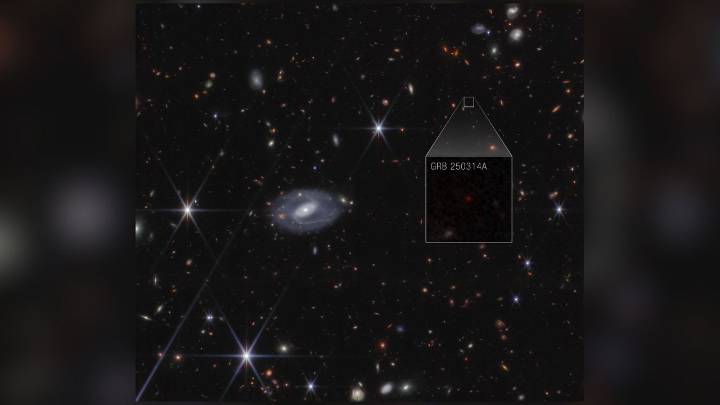
The light of the oldest supernova ever seen, dating back 13 billion years to just 730 million years after the Big Bang, has been captured by the James Webb Space Telescope.
The supernova was accompanied by a powerful gamma-ray burst (GRB), signifying the destruction of a massive star and possibly the birth of a stellar-mass black hole.
"There are only a handful of gamma-ray bursts in the last 50 years that have been detected in the first billion years of the universe," said Andrew Levan, of Radboud University in the Netherlands and the University of Warwick in the U.K., in a statement. "This particular event is very rare and very exciting."
The story begins on March 14, when the French–Chinese SVOM (Space-based multi-band astronomical Variable Objects Monitor) satellite detected a blast
 America News
 Santa Maria Times Safety
 Spectrum News Louisville
 Reuters US Business
 Orlando Sentinel Sports
 Raw Story
 CNN Politics