

 Reuters US Top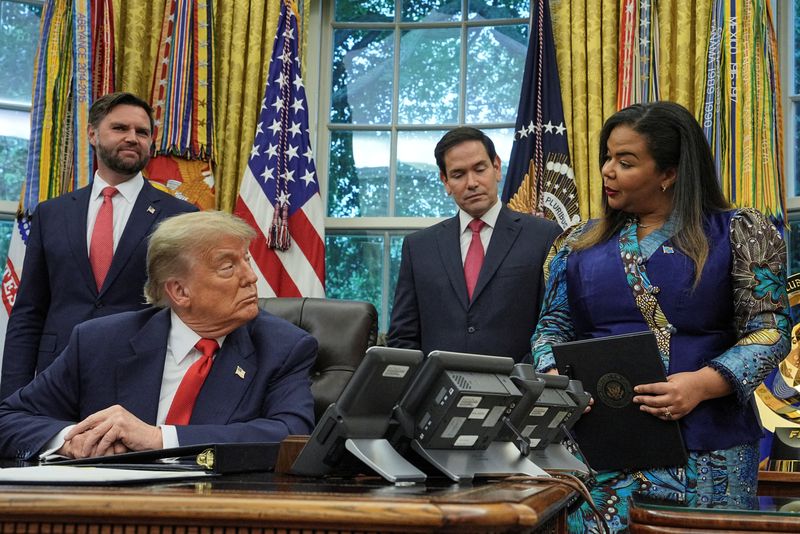
Dec 10 (Reuters) - Rwanda-backed M23 rebels have entered the eastern Congo town of Uvira, near the Burundian border, in the biggest escalation in months of the long-running war, sources told Reuters on Wednesday.
Uvira, on the shores of Lake Tanganyika, has served as the headquarters of the Kinshasa-appointed government in South Kivu province and its regional military base since the provincial capital, Bukavu, fell to M23 in February. Control of Uvira could open the way for the rebels to advance beyond South Kivu.
The latest breakthrough in M23's advance through the mineral-rich region comes less than a week after Congolese President Felix Tshisekedi and his Rwandan counterpart Paul Kagame met with President Donald Trump in Washington and affirmed their commitment to a U.S.-brokered peace deal.
Since then, Congo and Rwanda have accused each other of violating that agreement.
Congo's foreign minister has urged Washington to expand targeted sanctions against Rwanda to "restore the credibility" of its mediation efforts. Rwanda, which denies backing M23, has blamed Congolese forces and Burundi for the renewed fighting.
The violence in Uvira shows that merely signing deals in Washington is "not enough to ensure the safety of civilians in eastern Congo", said Lewis Mudge, Central Africa director for Human Rights Watch.
CONTROL OF UVIRA DISPUTED
The United Nations says some 200,000 people have fled their homes in recent days and scores of civilians have been killed.
It was not clear on Wednesday whether M23 had full control of Uvira.
"There's still shooting," said one resident who declined to be named for safety reasons. M23 was telling residents to stay home as its forces cleared out any resistance, the resident said.
A Congolese government source told Reuters that the military would not react, in order to protect civilians.
"The city of Uvira is now liberated," Lawrence Kanyuka, spokesperson for a coalition that includes M23, said on X.
But Burundi's foreign minister, Edouard Bizimana, told Reuters that Uvira "has not yet fallen."
REGIONAL VIOLENCE FEARED
M23 staged a lightning advance in eastern Congo in January, seizing more territory than ever before, including Goma and Bukavu, the region's two largest cities.
The rebels have since tightened their grip on power in areas under their control but had refrained from making major advances as they took part in peace talks led by Qatar in Doha.
Reuters reported on Monday that M23 had captured Luvungi, a town that had marked the front line since February, and that fierce fighting was underway near Sange and Kiliba, villages further along the road towards Uvira from the north.
On Tuesday, the U.S. and nine other members of the International Contact Group for the Great Lakes voiced "profound concern" over the renewed clashes in South Kivu, warning that the violence could destabilise the wider region.
In an interview with Reuters late on Tuesday, Congolese Foreign Minister Therese Kayikwamba Wagner said Washington should ramp up sanctions on Rwanda, targeting "individuals in the chain of command" and institutions such as the Rwandan military to curb its ability to buy weapons.
"Washington has to restore the credibility of its process through accountability," Wagner said. "It is not enough to condemn. It is not enough to be preoccupied or to be concerned."
RWANDA DEFENDS ITS POSITION
Rwanda says its troops are in eastern Congo for "defensive measures," although Washington and the United Nations say evidence of Rwandan support for the rebels is clear.
Rwandan Foreign Minister Olivier Nduhungirehe told Reuters on Wednesday that more sanctions would not end the fighting, blaming Kinshasa's failure to implement peace deals or honour an airstrike moratorium that he said was agreed in Washington last month.
Congolese forces have been attacking rebel positions and local communities in South Kivu province for "weeks and months" before the recent escalation, he said.
"The international community has not demanded an end to these attacks prepared for months by the DRC and instigated in the past week," Rwanda's foreign ministry said, adding that Burundi was helping Congolese forces bomb towns close to its border.
"The Burundian army has amassed close to 20,000 troops in South Kivu in the service of the government of DRC."
Burundi did not immediately respond to Rwanda's statement.
(Reporting by Ange Adihe Kasongo, Sonia Rolley and Congo newsroomAdditional reporting by Robbie Corey-Boulet and Clement ManirabarushaWriting by Robbie Corey-Boulet and Silvia AloisiEditing by Frances Kerry, Ros Russell and Toby Chopra)

 AlterNet
 Bloomberg Quicktake
 Reuters US Economy
 Raw Story
 The Atlantic
 RadarOnline