

 The Atlantic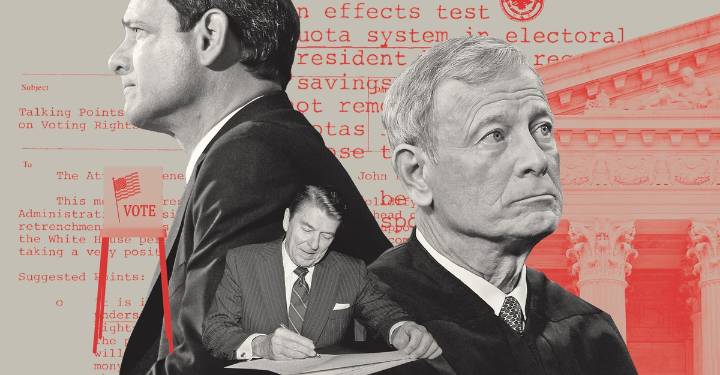
In 1982, when the Voting Rights Act was up for reauthorization, the Reagan Justice Department had a goal: preserve the VRA in name only, while rendering it unenforceable in practice. A young John Roberts was the architect of that campaign. He may soon get to finish what he started.
Last month, at the oral argument in Louisiana v. Callais, a majority of the conservative justices seemed to signal their willingness to forbid any use of race data in redistricting. That could lead to the end of the VRA’s Section 2 protections for minority voters, and allow states across the South to redraw congressional districts currently represented by Black Democrats into whiter, more rural, and more conservative seats, potentially before the 2026 midterms.
A central question of the case, hotly debated during oral arguments, is whether Section 2 should prohibit election laws and procedures that have a racially discriminatory effect, or just those passed with clear racially discriminatory intent. Roberts almost certainly had flashbacks. This is the same question that was at the center of the 1982 reauthorization fight. Back then, the future chief justice’s job was to design the Department of Justice’s VRA strategy.
When Roberts first arrived at DOJ in 1981, fresh off a clerkship for William Rehnquist at the Supreme Court, he was assigned two important portfolios: prepping Sandra Day O’Connor for her confirmation hearings and voting rights. O’Connor sailed through the Senate. The VRA would be more contentious: A 1980 Supreme Court decision in City of Mobile v. Bolden had required plaintiffs making a Section 2 claim to prove that lawmakers had racial-discrimination intent. That’s difficult to demonstrate, and it brought nearly all Section 2 litigation to a halt.
Civil-rights groups, Democrats, and moderate Republicans wanted to use the VRA reauthorization to override Mobile and clarify that Congress clearly meant to remedy all racially discriminatory effects. The Reagan administration was divided. Moderate Reaganites did not want to battle over the landmark law, which was popular. Ideological conservatives within DOJ spoiled for a fight. They were content to extend the act, just so long as it was impossible to use. Roberts led the way.
Roberts’s papers from this era, housed at the National Archives, show his determination and dedication. They include memos and talking points, draft op-eds, scripted answers for bosses to deliver in meetings and before Congress, and presentations he gave to senators and Hill staff. These files show how Roberts devised the messaging strategies that made it possible for the administration to claim it supported the VRA, while actually helping to neuter it—an approach he has since mastered as chief justice.
When Roberts started as a special assistant to Attorney General William French Smith at DOJ in August 1981, pragmatic White House aides who wanted to avoid the messiness of a voting-rights fight appeared to hold the winning hand. Earlier that summer, the conservative representative Henry Hyde had experienced something of a conversion after public hearings across the South, reversed his own position, and urged his old friend Ronald Reagan to come aboard. Reagan addressed a national NAACP convention that June and vowed he would never allow barriers to be placed between any citizen and the ballot box. By August, he told The Washington Star that he would back whatever 10-year reauthorization Congress sent him, punting the question of intent versus effects to lawmakers.
But that fall, as the White House planned to release a statement confirming that Reagan would support whatever compromise Congress reached, DOJ pushed back hard. The attorney general demanded a meeting with Reagan. Following the meeting, Reagan embraced two of Smith’s proposals—maintaining the intent standard, and making it easier for localities to escape Section 5 preclearance, which required all bodies in covered states to get approval before making any changes to election law or procedures. (Roberts would effectively end that requirement with his decision in 2013’s Shelby County v. Holder, neutering the law by freezing the formula that determined which states were covered.)
Reagan now declared the effects standard “new and untested”—a position that hewed almost verbatim to Roberts’s talking points. In his end-of-year news conference, Reagan channeled Roberts again. The effect rule “could lead to the type of thing in which effect could be judged if there was some disproportion in the number of officials who were elected at any governmental level,” Reagan said. “You could come down to where all of society had to have an actual quota system.”
[Listen: If the Voting Rights Act falls]
This is almost exactly what Roberts would write in his December 1981 memo titled “Why Section 2 of the Voting Rights Act Should Be Retained Unchanged”: “Incorporation of an effects test in §2 would establish essentially a quota system for electoral politics.” Then came the line that could be seen as defining decades of future jurisprudence: “Violations of §2 should not be made too easy to prove, since they provide a basis for the most intrusive interference imaginable by federal courts into state and local processes.”
Roberts inspired Reagan’s shift. His words and ideas made up the core of the president's statements. He placed the administration into an intent-versus-effects fight that Reagan’s political counselors thought unnecessary.
The next battle would be before the U.S. Senate. Roberts would script that too.
The Senate debate had kicked off with a mid-November New York Times op-ed from Vernon Jordan, then head of the National Urban League, titled “Diluting Voting Rights.” Roberts must not have liked what he read. Reagan’s endorsement of the intent standard “was not only a political mistake,” Jordan wrote, but a “disservice” to conservatism. Then the civil-rights leader lowered the boom. Intent to discriminate, he wrote, is impossible to prove.
“Local officials don’t wallpaper their offices with memos about how to restrict minority-group members’ access to the polling booth,” Jordan wrote. “Discriminatory effects, however, are clear to all.” Proving intent, he argued, shifted and required the burden of proof and required evidence that “would be virtually impossible to assemble.”
“The President’s endorsement of the Voting Rights Act,” he concluded, “is a sham.”
Roberts quickly drafted a counterattack and circulated it to DOJ higher-ups. The pugnacious response insists that the intent test would make a “radical change” to the Voting Rights Act and slams the House version as a “radical experiment.” Roberts conceded that local officials might not wallpaper their offices with racist memos, but insisted that “circumstantial evidence” would still suffice, “as Mr. Jordan presumably knows.”
“The only ones who could be disappointed by the President’s actions,” Roberts held, “are not those truly concerned about the right to vote but rather those who, for whatever reason, were simply spoiling for a fight,” fiercely attacking the integrity of a man who had devoted his life to the struggle for civil rights.
Roberts’s audience wasn’t civil-rights leaders or New York Times readers. The DOJ team needed to keep the number of Senate proponents for the intent test below 60, the threshold for defeating a filibuster. Senator Strom Thurmond chaired the Senate Judiciary Committee. Opponents of the VRA’s effects provision felt confident that they could engineer a host of obstructionist feints and amendments to block its passage. So it shocked them when Senator Charles Mathias, a Republican, filed his bill, which included the effects test, with 60 co-sponsors. If the coalition of 40 Democrats and 21 Republicans held, the reauthorization would pass easily. Thurmond sputtered in disbelief when informed of the number: “They must not have read the bill!”
A stunned Roberts prepared to fight on. “Do not be fooled by the House vote or the 61 Senate sponsors of the House bill into believing that the President cannot win on this issue,” Roberts wrote in a January 1982 memo to the attorney general. Roberts’s allies were segregationists, his math was bad, and his political instincts worse, but he urged his troops onward, confident in his own assessment of Congress. “Many members of the House did not know they were doing more than simply extending the Act, and several of the 61 Senators have already indicated that they only intended to support simple extension,” he wrote. “Once the senators are educated on the differences between the President’s position and the House bill, and the serious dangers in the House bill,” Roberts insisted, “solid support will emerge for the President’s position.”

 New York Daily News Crime
 Reuters US Politics
 Raw Story
 AlterNet
 Associated Press US News