

 Reuters US Domestic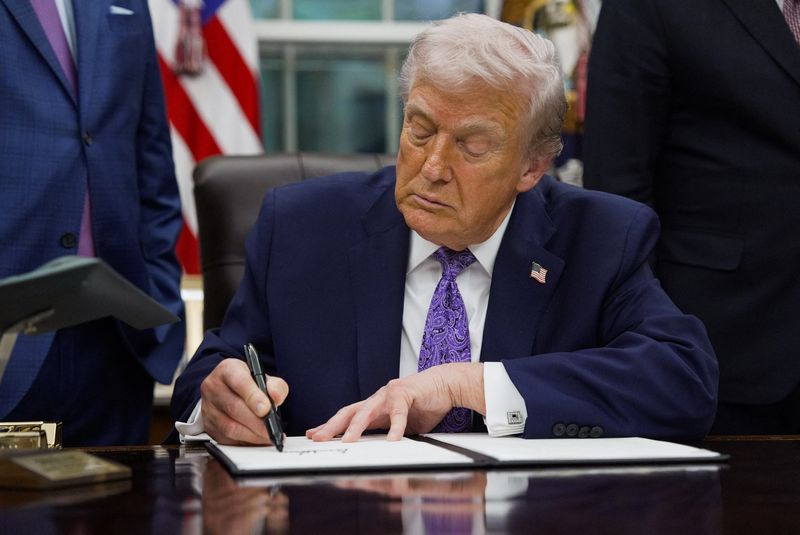
By Ross Kerber and Christian Martinez
Dec 11 (Reuters) - U.S. President Donald Trump signed an executive order aimed at increasing oversight of the proxy advisory industry, the White House said on Thursday, saying top firms often "advance and prioritize radical politically-motivated agendas."
In the order, posted on the White House website, Trump directed the U.S. Securities and Exchange Commission and other agencies to review if top proxy advisers Institutional Shareholder Services and Glass Lewis had violated rules or antitrust law related to their treatment of environmental and social issues. The order also directs the agencies, including the Federal Trade Commission and the Labor Department, to consider steps such as new regulations.
The order marks the latest conservative attack on the companies, which advise institutional investors how to vote in corporate elections. Both have been targeted by Republican politicians, business groups and executives including JP Morgan CEO Jamie Dimon and billionaire Elon Musk who say they have too much influence over decisions such as director contests or whether to approve executive pay.
In November, Reuters and other outlets reported the White House was exploring new limits on the firms.
But past Republican attempts to restrict the companies' business have met with mixed success amid court challenges and support from asset managers and investment groups. They say the firms simplify complex shareholder voting decisions.
Trade groups also once looked to the White House to restrict proxy voting by large funds. But those expectations have cooled and Trump's order on Thursday made no mention of the issue.
An ISS spokesman said via email that it will review Trump's order as it considers its next steps, "including to help mitigate any potential adverse impacts on clients."
The firm noted it is an SEC-registered investment adviser and said that "ISS does not dictate or set corporate governance standards and remains firmly committed to operating professionally, ethically, independently, and in the best interests of our clients, as we have done historically.”
Glass Lewis representatives did not immediately comment.
The order was the latest in a series targeting specific companies and industries. The president has previously taken aim at banks, accusing them of lending discrimination, and law firms he considers adversaries.
FOREIGN DOMINATION
Germany's Deutsche Boerse bought most of ISS in 2020. Glass Lewis is owned by Canadian private equity firm Peloton Capital and its chairman Stephen Smith. Trump noted the firms' foreign ownership, a previous line of Republican attacks.
Lately, both firms have drawn attention for their views on hot-button policy issues like whether companies should report their carbon emissions or workforce diversity statistics.
The firms and many supporters say they are only helping shareholders cast ballots in complex contests that have grown too unwieldy for amateurs to track. But amid a broader backlash against environmental and social investing concerns, this year both firms took steps like recommending many fewer climate proposals.
ISS also stopped considering boardroom diversity when making director recommendations, and Glass Lewis said it may register itself as an investment adviser.
But the firms have won legal victories, stalling Republican attempts to marginalize them. In August, a federal judge blocked Texas from enforcing a first-of-its kind law restricting them from advising shareholders on diversity and environmental matters.
IT'S NOT OVER
Also, in July, a federal appeals court sided with ISS and affirmed a lower court's ruling that the firm does not "solicit" proxy votes, preserving a lower-court decision to block proxy adviser regulations from 2020. Had the regulations held they could have required the proxy advisers to file their recommendations publicly, harming their business models.
Still, the firms face ongoing pressure such as in Florida, where both were sued by the state's Republican Attorney General James Uthmeier in November claiming they violated state consumer-protection and antitrust laws. Texas' Attorney General has launched a similar investigation. In his order, Trump directed the chairman of the FTC and U.S. Attorney General Pam Bondi to review if the state probes found potential federal antitrust violations.
(Reporting by Bhargav Archaya and Ross Kerber; Writing by Ross Kerber and Christian Martinez; Editing by Muralikumar Anantharaman, Chris Reese and Diane Craft)

 AlterNet
 CNN
CNN Raw Story
 ABC News
 Santa Maria Times Safety