

 Space.com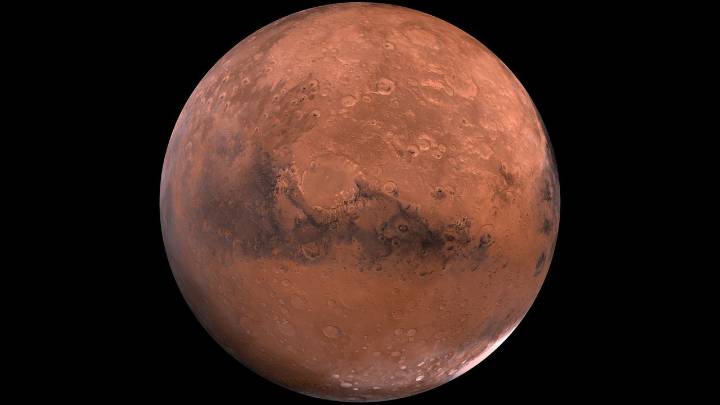
Time passes, on average, 477 millionths of a second faster per day on Mars than on Earth thanks to the impact of Albert Einstein's theory of general relativity. Scientists say this will have repercussions for future navigation and communication networks that may span the inner solar system.
Neil Ashby and Bijunath Patla of NIST, the National Institute of Standards and Technology in the U.S., calculated the time discrepancy between Mars and Earth by considering the strength of gravity on Mars (which is five times weaker than on Earth), the velocity and eccentricity of the Red Planet's orbit around the sun, and the gravitational influence of not only the sun but also Mars' nearest neighbors, Earth and our moon.
"[Mars'] distance from the sun and its eccentric orbit make the variations in t

 VICE
VICE Orlando Sentinel
 Spectrum News Louisville
 New York Post
 Space War
 The Babylon Bee
 ABC 7 Chicago Politics
 AlterNet
 The Travel