

 Reuters US Top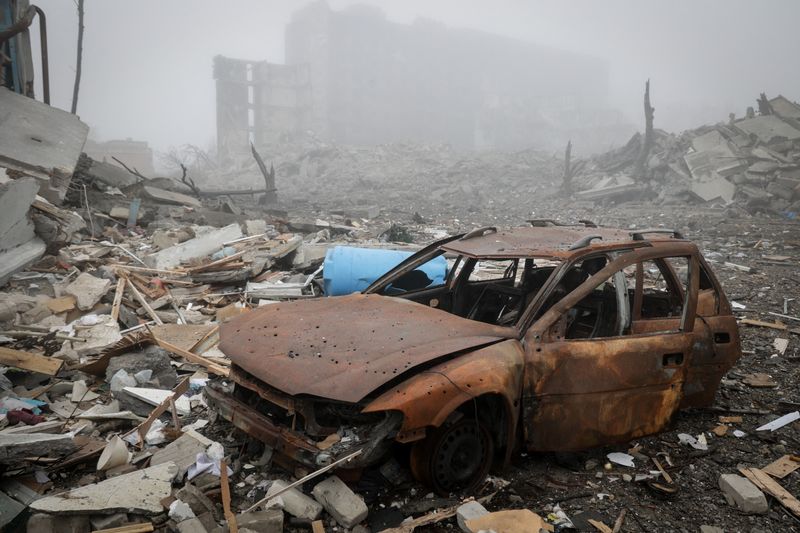
By Andrew Osborn
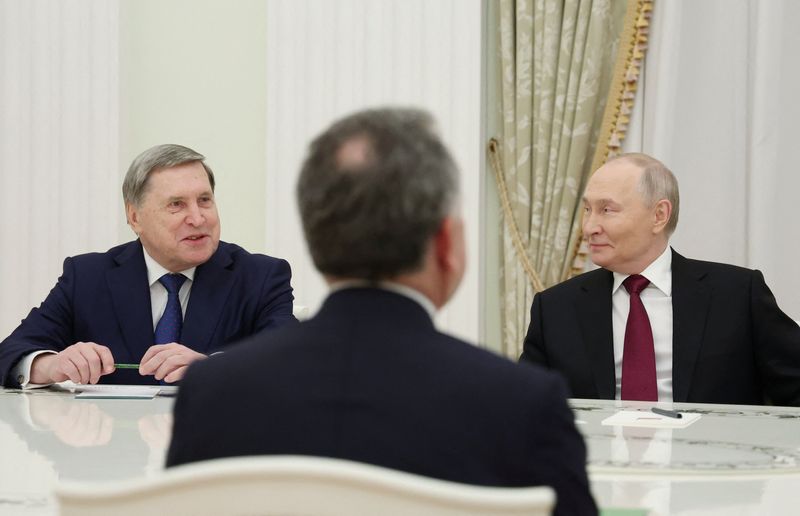
MOSCOW, Dec 3 (Reuters) - Talks between Russian President Vladimir Putin and U.S. envoys on Tuesday yielded no public breakthrough on a potential Ukraine peace deal, with Kremlin aide Yuri Ushakov suggesting unsolved "territorial problems" were the main stumbling block.
He was referring to Russian claims on all of Ukraine's eastern region of Donetsk, part of which remains in Ukrainian hands nearly four years after Putin sent tens of thousands of troops into Ukraine and over a decade after a Russia-backed separatist rebellion in Donetsk.
Almost all countries recognise Donetsk as part of Ukraine but it is one of four regions in eastern Ukraine that Moscow said it was annexing in 2022 following referendums dismissed by Kyiv and Western nations as a sham.
U.S. Secretary of State Marco Rubio told Fox News the war was now about the 20% - or just over 5,000 square km (1,900 square miles) of Donetsk that Russia does not control but wants.
Here is why Donetsk has a critical role in peace talks.
WHAT WAS PUTIN'S JUSTIFICATION FOR FULL-SCALE WAR?
Putin said when sending troops into Ukraine in 2022 that his goal was "to protect people who have been subjected to bullying and genocide... for the last eight years."
Ukraine and its allies said his statement was a false pretext for a war of colonial-style conquest.
Putin's assertion was a reference to how Ukraine fought back against the Russia-backed separatists in the Donetsk and Luhansk regions who broke away from Ukrainian government control in 2014 and seized chunks of territory.
In the conflict that followed in eastern Ukraine, the sides traded accusations of shelling cities and civilians. Moscow cited the region's large Russian-speaking population to say it had a moral duty to intervene in 2022.
Kyiv said it had no choice but to respond with force in 2014 to protect Ukraine's territorial integrity and it too accused separatist forces of shelling cities and civilians.
The United Nations estimates that 3,106 civilians were killed on both sides in fighting between Ukrainian government forces and separatists between 2014 and the start of 2022, and that up to 9,000 civilians were wounded.
WHAT IS THE MILITARY IMPORTANCE OF DONETSK?
The remainder of Donetsk which Russia covets includes Sloviansk and Kramatorsk, "fortress cities" used by Ukraine's military as hubs since 2014.
They are vital to Kyiv's defence of the rest of Ukraine as the land west of Donetsk is much flatter, with vast open fields, which would make it easier for Russia to advance beyond Donetsk and take territory on the eastern bank of the River Dnipro.
The cities are part of a heavily fortified line of defences, including trenches, anti-tank obstacles, bunkers and minefields that are located around them.
Ukrainian President Volodymyr Zelenskiy has said that handing over the rest of Donetsk would be illegal without a referendum and give Russia a platform to launch assaults deeper into Ukraine in the future.
Kyiv fears that if it surrenders the rest of Donetsk, Russia would re-arm and at some point use Donetsk to sweep westwards.
HOW DO RUSSIANS AND UKRAINIANS REGARD DONETSK?
Both sides have suffered heavy casualties and expended vast amounts of money and equipment fighting over Donetsk, including for the city of Bakhmut, where Russia threw tens of thousands of convicts turned mercenaries into what became known as a meat grinder.
Donetsk has taken on more significance in the public mindset in both countries because of this, making it harder for either to change its stance.
Ukraine does not want to gift Russia territory it has failed to win on the battlefield, and Zelenskiy has said Moscow should not be rewarded for a war it started.
The U.S.-based Institute for the Study of War said in October that the rate of Russia's advance did not suggest it was about to seize the rest of Donetsk but might take it by August 2027 "assuming a constant Russian rate of advance."
Russian commanders are more bullish. Valery Gerasimov, the chief of the General Staff, told Putin on Sunday that Moscow's forces were advancing along the entire front line and working towards taking full control of Donbas.
WHAT INDUSTRY DOES DONETSK HAVE?
Donetsk is home to ports, railways and other heavy industry. It once accounted for more than half of Ukraine's coal, finished steel, coke, cast iron and steel production but many mines and facilities have been destroyed in the war.
Donetsk also has rare earths, titanium and zirconium - a source of revenue for whoever controls it.
The fate of Donetsk is one factor that is likely to shape the historical legacy of Putin and Zelenskiy.
Putin has cast himself as the defender of ethnic Russians wherever they are. Securing all of Donetsk is central to that narrative.
Zelenskiy came to power in 2019 vowing to end the war in eastern Ukraine. Since 2022, he has gained a reputation as the defiant defender of outgunned and outnumbered Ukraine in the face of a much bigger, hostile neighbour.
Giving up Donetsk without a fight - ceding territory where at least a quarter of a million Ukrainians live - could be seen as a betrayal by Ukrainians, many of whom have lost relatives on the battlefield.
A narrow majority of Ukrainians still oppose territorial concessions, according to a recent poll by the Kyiv International Institute of Sociology.
WHAT ARE UKRAINE'S LEGAL CONSIDERATIONS?
Ukrainian officials, including Zelenskiy, have rejected the prospect of surrendering land Kyiv controls under any peace deal.
Zelenskiy says he does not have a mandate to give away territory and that tracts of state land cannot be traded around as if they were his private property.
Under Ukraine's constitution, territorial changes must be settled by a referendum that can be called if it has the signatures of 3 million eligible Ukrainian voters in at least two-thirds of Ukraine's regions.
U.S. President Donald Trump has criticised the notion that what he has called a land swap would require a referendum and said "there will be some land swapping going on."
(Reporting by Andrew Osborn in Moscow, Additional reporting by the Kyiv Buro and by Dan Peleschuk in Kyiv, Editing by Timothy Heritage)

 CNN
CNN CNN Video
 TIME
TIME Chicago Tribune
 America News
 Reuters US Business
 KCRA News
 WAND TV
 ABC30 Fresno Entertainment
 The Hill