

 USA TODAY National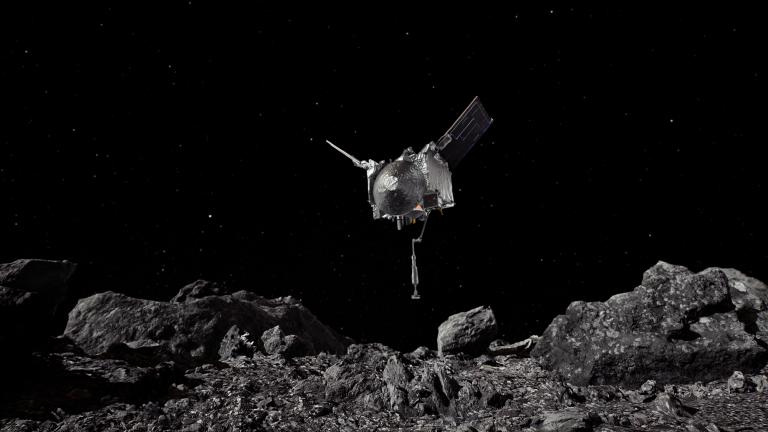

The Bennu asteroid, a space rock not too far from Earth that is rich in carbon, continues to be a trove of information for scientists keen to learn about how life may have begun in our solar system.
More than two years ago, a robotic spacecraft dropped off a delivery of rocky samples from the surface of Bennu. The material has been a gift to the world's researchers, who soon found signs that asteroids that collided with Earth billions of years ago may have given rise to life on the planet.
In the latest discoveries, multiple teams of researchers have found a bevy of interesting characteristics contained within Bennu's surface material. That includes sugars essential for biology, a surprisingly high amount of stardust from a supernova explosion and ... something NASA is calling space gum?
The discoveries were outlined across three new papers published Tuesday, Dec. 2, in the journals Nature Geosciences and Nature Astronomy, which NASA summed up in a blog post.
Here's more about what researchers discovered, including just what this space gum could be.
OSIRIS-REx returns Bennu samples to Earth
A spacecraft named OSIRIS-REx made history as part of the first U.S. mission to gather and return a sample of an asteroid when it delivered material in September 2023 to Earth from a space rock named Bennu.
Launched on Sept. 8, 2016, OSIRIS-REx is short for a mouthful: Origins, Spectral Interpretation, Resource Identification, and Security-Regolith Explorer. The spacecraft collected a sample of rocks and dust in October 2020 from the surface of Bennu, which is close enough to be considered a near-Earth asteroid.
Those samples made it back to Earth when OSIRIS-REx released a parachute carrying a capsule with grains of Bennu over Earth’s atmosphere. It landed at the Department of War's Utah Test and Training Range.
What did NASA find on Bennu asteroid?
In January 2025, scientists released the first findings from analysis of the Bennu sample, which showed evidence that asteroids could have brought the building blocks of life to Earth.
Though those initial findings did not show evidence of life itself, they did suggest the conditions necessary for the emergence of life were widespread across the early solar system, NASA said in a statement at the time.
Now, scientists who have studied the samples have found more clues on Bennu about how life may have begun in our solar system.
One group of researchers in Japan, for instance, found sugar ribose and – in a major first – glucose.
For life on Earth, the sugars deoxyribose – which the researchers did not detect – and ribose are key building blocks of DNA and RNA, respectively. Glucose, meanwhile, is among the most common forms of food, or energy, for life on Earth – an important clue that the source for life as we know it was present in the early solar system.
Another group of researchers at NASA’s Johnson Space Center in Houston took a look at "dust" from stars in the sample − material older than our own solar system. Called presolar grains, the supernova dust provided context about Bennu's parent planetary body, which likely formed in a region of the doughnut-shaped disk of gas and dust that circles young stars, known as a protoplanetary disk.
What is 'space gum?'
Perhaps most intriguingly, a team of researchers from California took a look at gum-like material in the Bennu samples that have never been seen before in space rocks.
The strange pliable substance, which NASA said is not unlike used gum or soft plastic, was probably formed when our solar system was in its infancy. At the time, Bennu's parent asteroid would have been warming and forming from materials in the solar nebula, the rotating cloud of gas and dust from which our sun and neighboring planets formed.
The ancient “space gum,” as NASA called it, consists of polymer-like materials rich in nitrogen and oxygen that could have helped spark life on Earth.
"Finding them in the pristine samples from Bennu is important for scientists studying how life began and whether it exists beyond our planet," NASA said.
OSIRIS-REx renamed, sent on mission to Apophis
OSIRIS-REx was renamed in December 2023 and sent on a path that would allow it to meet up with an infamous asteroid in 2029.
That asteroid is named Apophis, and it had appeared to pose a sizable threat to Earth when it was discovered in 2004 before scientists eventually calculated that its trajectory was harmless. OSIRIS-APEX (short for Apophis Explorer) is meant to spend 18 months mapping the asteroid’s surface and analyzing its chemical makeup during a rendezvous with Apophis in June 2029, two months after the asteroid has a close encounter with Earth.
Scientists consider the mission an invaluable endeavor to allow NASA and other space agencies to build up planetary defense capabilities if a space rock ever posed a threat to Earth.
NASA recently received images and data returned by OSIRIS-APEX when it flew within 2,136 miles of Earth at the end of September, the agency said in a blog post. Nov. 25.
Contributing: Doyle Rice
Eric Lagatta is the Space Connect reporter for the USA TODAY Network. Reach him at elagatta@gannett.com
This article originally appeared on USA TODAY: 'Space gum,' sugars crucial for life found on Bennu sample, NASA says
Reporting by Eric Lagatta, USA TODAY / USA TODAY
USA TODAY Network via Reuters Connect

 Siskiyou Daily News
 Sarasota Herald-Tribune
 NPR
NPR Futurism
 IFL Science
 Q105.7 & 103.5
 Raw Story
 Atlanta Black Star Entertainment