

 The Atlantic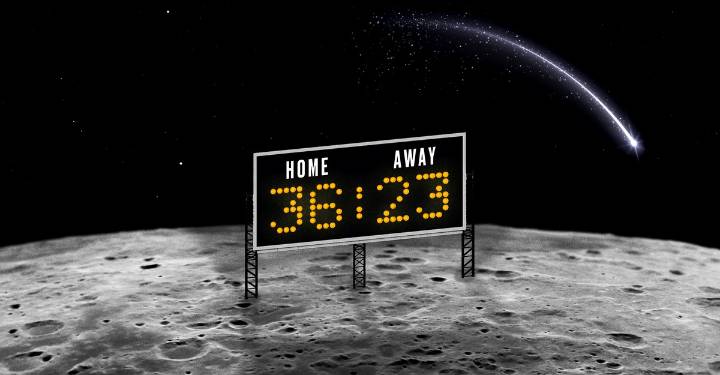
There was no good reason to be thinking about NFL history when the Dallas Cowboys took on the Las Vegas Raiders a couple of weeks ago. Neither team had a winning record at the time, and the score was never close after halftime. But as the game stretched on that Monday night, the sportswriter and video maker Jon Bois sensed that something unprecedented could be afoot. “I glanced up and realized 36–23 was very much in play,” he told me.
Bois is the mind behind “Scorigami,” a term he defines as “the act, and art, of producing a final score in a football game that has never happened before.” He conjured that portmanteau after a 2014 Seattle Seahawks victory over the Green Bay Packers. That game finished 36–16, the first time those two numbers had ever appeared side by side at the end of an official NFL contest.
In the 11 years since, Scorigami-watching has become a national pastime. Throughout the NFL season, fans of football and whole numbers keep a weekly vigil, hoping for novel combinations. Sometimes, their dedication is rewarded with a score that has never been achieved in any of the 18,000-plus regular-season and postseason games found in official league records. Since Bois’s coinage, we’ve celebrated 78 more Scorigamis, including four this year: 41–40, 40–40, 36–29, and 44–32. In a world suddenly awash with legalized sports betting and its associated ills, tracking these football digits is a comparatively wholesome compulsion. Scorigami is a game within the game that anyone can follow, one in which the teams and players are irrelevant. All that matters is the scoreboard.
For those keeping count, there have now been 1,095 unique scorelines in NFL history. But one never-before-seen Scorigami stands apart from all the others, on account of its maddening elusiveness: 36–23.
Some Scorigamis haven’t happened for a reason: You wouldn’t expect an NFL game to finish 83–12. But the somewhat normal-sounding 36–23—a single touchdown and an extra point off the Seahawks–Packers score that inspired Bois’s whole Scorigami conceit—has also remained out of reach. Indeed, scan across and down the NFL Scorigami grid, and you’ll find that given one team’s score of 23 points, opponents have put up every point total between six and 49. Every total, that is, except for 36.
Dave Mattingly, the programmer behind the NFL Scorigami website and a companion social-media bot with more than 500,000 followers, said the evasiveness of 36–23 has become “something of a meme” among the online score-monitoring community. Mattingly’s bot, which he engineered to spit out live Scorigami predictions for every NFL game, has posted, “Most likely Scorigami: 36–23,” a gobsmacking number of times, to no avail. A few representative replies: “Please 36-23 at long last igami,” “How has 36-23 never happenedigami,” and “36-23 needs to be a national holiday when it hitsigami.”
[From the November 1910 issue: Football at Harvard and Yale]
National 36–23 Day is the NFL’s perpetual broken promise. Bois was primed to celebrate a few weeks back, when the Cowboys were up 33–16 on the Raiders with four minutes to go. The Scorigami was right there—just a field goal, touchdown, and extra point away. But when the Dallas offense stalled deep in Las Vegas territory, the Cowboys went for it on fourth down rather than opting for the sure three points. It was a sensible move strategically but devastating Scorigamically. The final score: that same ho-hum 33–16, for the tenth time in NFL history.
“Man,” Bois told me, “the second it looks like it might happen, 36–23 keeps finding some unexpected way to give us the slip.”
That slipperiness, and Scorigamis more broadly, have been the subject of deep study over the past year. Nate Silver recently analyzed the NFL’s “Scorigami Era,” in which the combination of prolific offenses and placekickers, updated kickoff rules, and aggressive coaches have produced a raft of unusual scores. The academic researchers Liam Moyer, Jameson Railey, Andrew Daw, and Samuel C. Gutekunst—who collectively specialize in computer science, data sciences and operations, and mathematics—published a 2024 paper on a new model to “forecast likely future Scorigamis.” And Bois himself, along with his co-producer Alex Rubenstein, released a four-part Scorigami series on YouTube, culminating in an 88-minute finale on the next frontier of NFL scores.
All of these experts reached very similar conclusions: 36–23 is the “most likely unrealized Scorigami,” according to Silver, who described it as “honestly, not that weird a score” compared with goofier possibilities like 40–19 and 33–11. Daw, Gutekunst, and their colleagues originally had a different score, 32–26, as their top candidate for the next Scorigami triumph; when the Jets and the Dolphins took those numbers off the board last December, 36–23 became their top contender as well.
Exactly how likely is a 36–23 NFL game? Scorigami simulations by both Silver and the academics found that, given modern scoring conditions, it should pop up roughly once every 1,400 games. By Daw and Gutekunst’s numbers, there’s a 50 percent chance that we’ll see 36–23 by the end of the 2028–29 season. There’s also a 0.6 percent chance that it won’t happen by 2050.
Bois and Rubenstein, for their part, have decreed that 36–23 is “overdue.” They’ve also unearthed one very close call—what Rubenstein referred to as “a malfunction in the space-time continuum that clearly was supposed to end 36–23 and didn’t.” Back in 2014, the Steelers were leading the Ravens 36–23 with two minutes to go, and needed just two yards to ice the game and clinch the Scorigami. Instead, Pittsburgh got a 33-yard touchdown pass from Ben Roethlisberger to tight end Matt Spaeth. I think that Spaeth’s knee might have been down before the ball crossed the goal line. But in the record books, the final score was 43–23, for the third time ever.
This agonizing 36–23 drought is strictly an NFL phenomenon. According to the data clearinghouse Sports Reference, there have been nine 36–23 games in major college football since 1968, the most recent coming last November. The Canadian Football League has also played host to four 36–23 games in its 67-year history, including the Winnipeg Blue Bombers’ win over the Edmonton Elks earlier this year.
Once you start looking for it, you can find 36–23 pretty much everywhere. In the past five weeks, the score turned up in an NCAA Division III game; in the Texas high-school playoffs; and on a junior-varsity field in California’s Central Valley. Further back in time, 36–23 games have been contested in the Hawaii–Aleutian Time Zone, in a now-defunct, college all-star game called the Challenge Bowl, and in a second-tier arena league. That is, in nearly every football setting ever invented except the National Football League.
There is one caveat: At least two NFL preseason games have finished 36–23. But Bois believes that exhibition football shouldn’t register Scorigami-wise, because it’s essentially a different sport, one in which the main goals are injury avoidance and carving out playing time for backups. “When a 36–23 happens in preseason, it feels to me like we didn’t really come by it honestly,” he said.
So what would it take to come by 36–23 honestly?
The 23 part isn’t really an issue. Twenty-three is currently in the sweet spot for NFL scoring—teams have averaged 22.9 points per game so far this year—and it’s easily achievable with football-friendly sevens and threes: All you need is two touchdowns, two extra points, and three field goals. Scoring 36 on the dot is far more unusual; it’s taken place only 155 times in NFL history and just once so far this year. (That game happened to be a Scorigami, too.) Although you can get to 36 with sevens and threes—three touchdowns plus extra points and five field goals—that exact combination of events is extremely uncommon. When a team hits 36, it’s more likely the result of a missed extra point, a made or missed two-point conversion, a two-point safety, or some mishmash of the above.

 NFL Detroit Lions
 KAKE
KAKE Rockford Register Star Sports
 Bolavip Football
 Newsday
 Wyoming Tribune Eagle
 Scottsdale Independent
 NFL Seattle Seahawks
 6abc Action News Sports
 The Conversation