

 The Conversation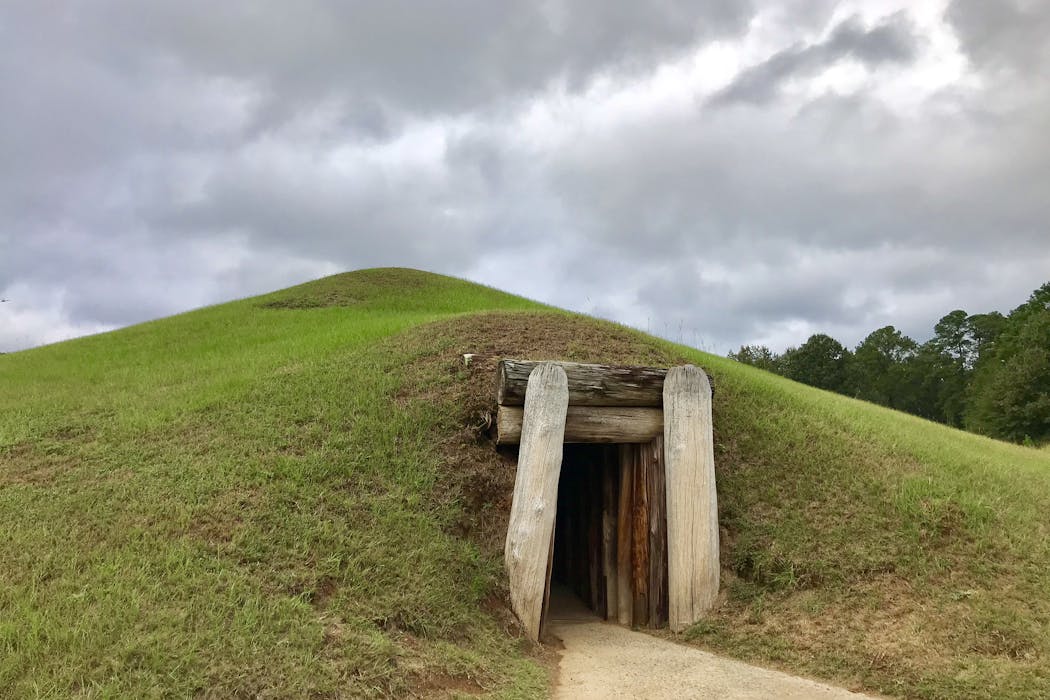
Ocmulgee Mounds, a site in central Georgia with 12,000 years of Indigenous history, may be on the verge of becoming the newest U.S. national park. This is the flagship designation of the National Park Service system, which includes many types of properties in addition to formally designated national parks.
Although this redesignation may not include much change for the site itself, it could mean quite a lot to visitors, supporters and locals alike.
The 3,000-acre park protects land and features important to the Mississippian culture, which built the mounds there starting roughly 3,000 years ago, and the Muscogee (Creek) Nation, for which the site is an ancestral homeland.
The site includes seven enormous ceremonial and burial mounds made of earth, the largest of which is 55 feet (15 meters) tall and covers about 2 acres, as well as a museum containing millions of cultural artifacts, including pottery, stone tools, jewelry and bells.
The National Park Service has managed the site since the 1930s, first as a national monument and since 2019, as a national historical park. There are no legal or practical differences in protection between these redesignations, though the branding and marketing of the site may change.
As a geographer who studies parks and the naming of places, I have seen that when a National Park Service unit is redesignated as a national park, as a pending bill in Congress currently proposes for Ocmulgee Mounds, it does not typically change the funding available to run the site. That’s especially true at a time when National Park Service funding and personnel are being cut. However, a park redesignation does serve political purposes and affects how visitors perceive that park.

How parks are designated
The National Park Service manages 433 units with 19 different designations, such as “national battlefields,” “national lakeshores” and “national scenic trails.” Only 63 of these units carry the formal title or designation of “national park.”
All but one of these categories can be bestowed only by Congress. National monuments, however, can be created by the president directly, under the provisions of the Antiquities Act of 1906.
For example, the Antiquities Act allowed President Barack Obama to designate 1.3 million acres in Utah as Bears Ears National Monument in a December 2016 proclamation. That same act allowed President Donald Trump to shrink the protected area to 200,000 acres in 2017 – and President Joe Biden to re-expand it to 1.3 million acres in 2021.
Other examples of redesignation
In rare cases, a community, group or other organization proposes adding an area that is not currently managed by the National Park Service to the system, but this takes a lot of time and is different from the more common process of changing the formal designation of a property already within the system.
For instance, Indiana Dunes National Lakeshore became Indiana Dunes National Park in 2019. That same year, White Sands National Monument in New Mexico became White Sands National Park. And in 2020, New River Gorge National River in West Virginia became New River Gorge National Park and Preserve.

Why redesignations make a difference
My analysis of the contentious redesignation of the Jefferson National Expansion Memorial in St. Louis to Gateway Arch National Park in 2018 found that it was not done to offer additional protection to this site of national importance. Rather, the move was meant to take advantage of the public significance of the “national park” label and thereby attract more tourists and tourism revenue to the local economy.
The effort to make it a national park was part of a local campaign to renovate the underground visitor center, revitalize the park grounds and increase tourism. But the law that formalized the change included no additional funding, resources or protections for the Gateway Arch.
Changing the designation contradicted the park service’s own declaration that the term “national park” should be used for an area that “contains a variety of resources and encompasses large land or water areas to help provide adequate protection of the resources.”
During congressional hearings, the deputy director of the National Park Service, Robert Vogel, recommended the site not be labeled a national park but rather a national monument, because the site “is too small and limited in the range of resources the site protects and interprets to be called a national park.”
Gateway Arch National Park is now the smallest-area park in the U.S., at less than 200 acres, and is home to a large steel arch, an open lawn area, a museum and a single historic building – a courthouse where one of the Dred Scott trials was heard, along with other civil rights cases. It does not have the wildlife viewing, spectacular geologic features, outdoor recreation opportunities and sense of wilderness that the public has come to expect from national parks.
The park’s website admits “it is unusual for a national park to have no natural plant life” and describes the park as adjacent to the “concrete jungle of downtown St. Louis.”
What actually would change for Ocmulgee Mounds?
The redesignation effort for Ocmulgee Mounds has two primary aspects. First, it would declare the area a national park.
Second, it would add additional land to this protected area, designating that portion as a national preserve. The distinction matters: Public hunting, including traditional Indigenous hunting, is not allowed in national parks, but it is allowed in national preserves. And while national parks are managed by the National Park Service under the Department of Interior, national preserves can be managed in collaborative partnership with other groups, including local Indigenous people with cultural ties to the land.
The changes for Ocmulgee Mounds are supported by members of both political parties in both houses of Congress. And the redesignation does not appear to have triggered opposition from local communities, who in other places have objected for several reasons, including fear of increased tourism and desire to preserve any long-standing uses of the land that would be banned if it were to become a national park.
There are redesignation efforts underway seeking to make national parks in other locations as well, including the Delaware Water Gap National Recreation Area in New Jersey and Pennsylvania, Chiricahua National Monument in Arizona, Buffalo National River in Arkansas, and Apostle Islands National Lakeshore in Wisconsin.
The only real changes in these places, though, would be in marketing – the signs, brochures and merchandise sold in gift shops. But these changes would have an important effect: The tagline of “new national park” markets well and is believed to help attract more visitors to the site. But it won’t actually protect these landscapes any better than they already are under the stewardship of the National Park Service.
This article is republished from The Conversation, a nonprofit, independent news organization bringing you facts and trustworthy analysis to help you make sense of our complex world. It was written by: Seth T. Kannarr, University of Tennessee
Read more:
- Hidden treasures of America’s national parks are closer than you might think
- Yosemite embodies the long war over US national park privatization
- National parks are key conservation areas for wildlife and natural resources
Seth T. Kannarr does not work for, consult, own shares in or receive funding from any company or organization that would benefit from this article, and has disclosed no relevant affiliations beyond their academic appointment.


 The Jersey Journal
 Vermont Public
 Daily Voice
 Raw Story
 The Babylon Bee
 The radio station 99.5 The Apple
 WILX News 10
 The Outer Banks Voice Community
 New York Post