

 The Conversation
When pregnant women drink water that comes from wells downstream of sites contaminated with PFAS, known as “forever chemicals,” the risks to their babies’ health substantially increase, a new study found. These risks include the chance of low birth weight, preterm birth and infant mortality.
Even more troubling, our team of economic researchers and hydrologists found that PFAS exposure increases the likelihood of extremely low-weight and extremely preterm births, which are strongly associated with lifelong health challenges.
What wells showed us about PFAS risks
PFAS, or perfluoroalkyl and polyfluoroalkyl substances, have captured the attention of the public and regulators in recent years for good reason. These man-made compounds persist in the environment, accumulate in human bodies and may cause harm even at extremely low concentrations.
Most current knowledge about the reproductive effects of PFAS comes from laboratory studies on animals such as rats, or from correlations between PFAS levels in human blood and health outcomes.
Both approaches have important limitations. Rats and humans have different bodies, exposures and living conditions. And independent factors, such as kidney functioning, may in some cases be the true drivers of health problems.
We wanted to learn about the effects of PFAS on real-world human lives in a way that comes as close as possible to a randomized experiment. Intentionally exposing people to PFAS would be unethical, but the environment gave us a natural experiment of its own.
We looked at the locations of wells that supply New Hampshire residents with drinking water and how those locations related to birth outcomes.
We collected data on all births in the state from 2010 to 2019 and zoomed in on the 11,539 births that occurred within 3.1 miles (5 kilometers) of a site known to be contaminated with PFAS and where the mothers were served by public water systems. Some contamination came from industries, other from landfills or firefighting activities.

PFAS from contaminated sites slowly migrate down through soil into groundwater, where they move downstream with the groundwater’s flow. This created a simple but powerful contrast: pregnant women whose homes received water from wells that were downstream, in groundwater terms, from the PFAS source were likely to have been exposed to PFAS from the contaminated site, but those who received water from wells that were upstream of those sites should not have been exposed.
Using outside data on PFAS testing, we confirmed that PFAS levels were indeed greater in “downstream” wells than in “upstream” wells.
The locations of utilities’ drinking water wells are sensitive data that are not publicly available, so the women likely would not have known whether they were exposed. Prior to the state beginning to test for PFAS in 2016, they may not have even known the nearby site had PFAS.
PFAS connections to the riskiest births
We found what we believe is clear evidence of harm from PFAS exposure.
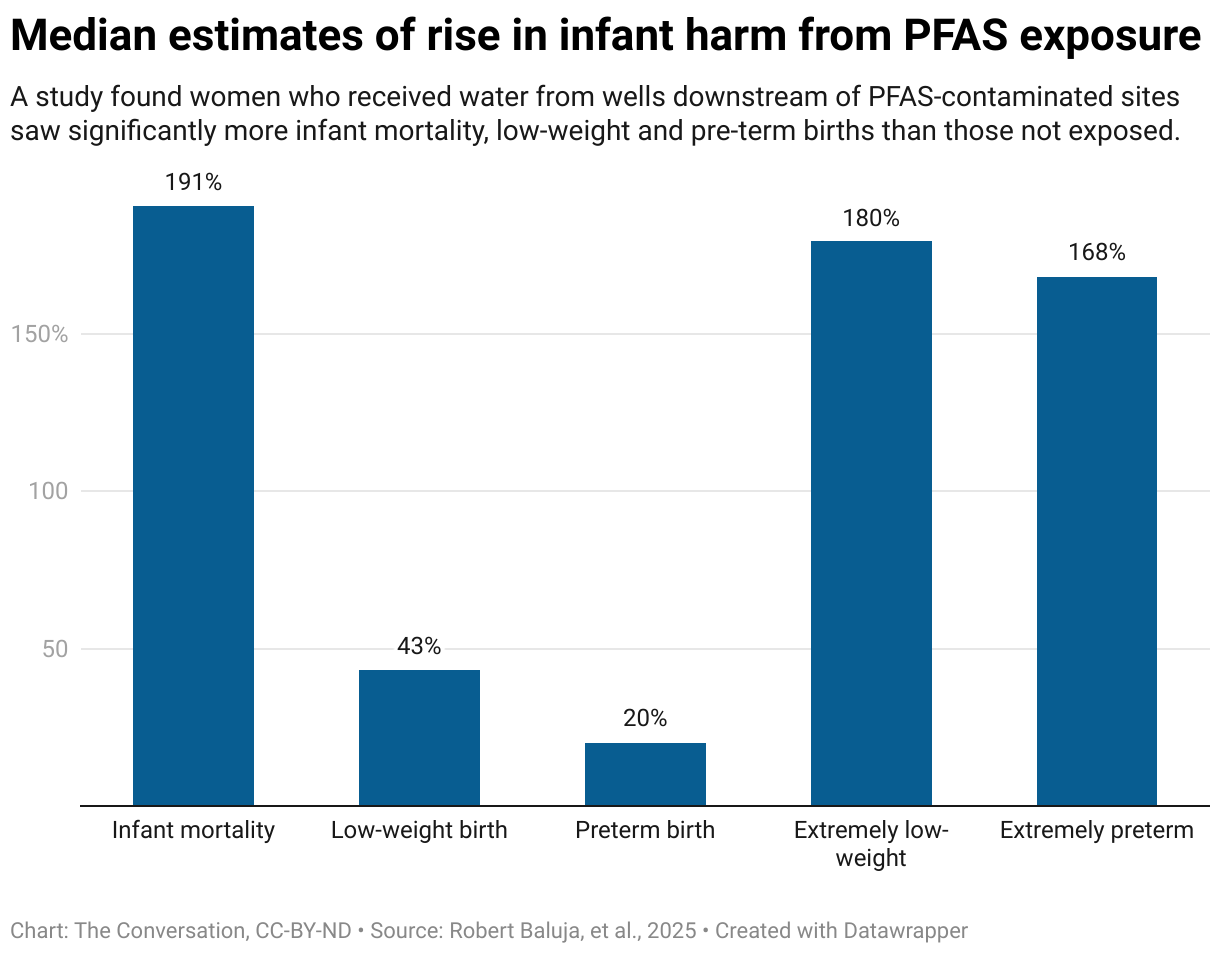
Women who received water from wells downstream of PFAS-contaminated sites had on average a 43% greater chance of having a low-weight baby, defined as under 5.5 pounds (2,500 grams) at birth, than those receiving water from upstream wells with no other PFAS sources nearby. Those downstream had a 20% greater chance of a preterm birth, defined as before 37 weeks, and a 191% greater chance of the infant not surviving its first year.
Per 100,000 births, this works out to 2,639 additional low-weight births, 1,475 additional preterm births and 611 additional deaths in the first year of life.
Looking at the cases with the lowest birth weights and earliest preterm births, we found that the women receiving water from wells downstream from PFAS sources had a 180% greater chance of a birth under 2.2 pounds (1,000 grams) and a 168% greater chance of a birth before 28 weeks than those with upstream wells. Per 100,000 births, that’s about 607 additional extremely low-weight births and 466 additional extremely preterm births.
PFAS contamination is costly
When considering regulations to control PFAS, it helps to express the benefits of PFAS cleanup in monetary terms to compare them to the costs of cleanup.
Researchers use various methods to put a dollar value on the cost of low-weight and preterm births based on their higher medical bills, lower subsequent health and decreased lifetime earnings.
We used the New Hampshire data and locations of PFAS-contaminated sites in 11 other states with detailed PFAS testing to estimate costs from PFAS exposure nationwide related to low birth weight, preterm births and infant mortality.
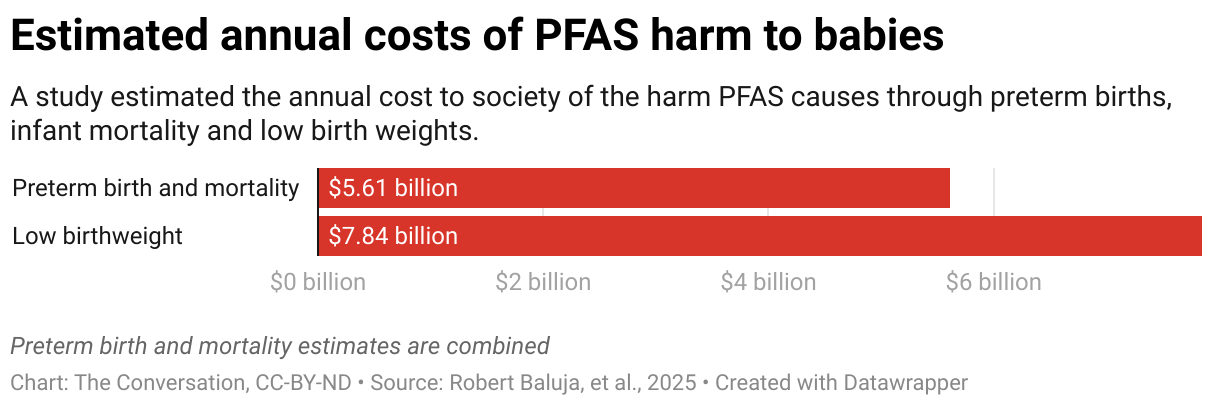
The results are eye-opening. We estimate that the effects of PFAS on each year’s low-weight births cost society about US$7.8 billion over the lifetimes of those babies, with more babies born every year.
We found the effects of PFAS on preterm births and infant mortality cost the U.S. about $5.6 billion over the lifetimes of those babies born each year, with some of these costs overlapping with the costs associated with low-weight births.
An analysis produced for the American Water Works Association estimated that removing PFAS from drinking water to meet the EPA’s PFAS limits would cost utilities alone $3.8 billion on an annual basis. These costs could ultimately fall on water customers, but the broader public also bears much of the cost of harm to fetuses.
We believe that just the reproductive health benefits of protecting water systems from PFAS contamination could justify the EPA’s rule.
Treating PFAS
There is still much to learn about the risks from PFAS and how to avoid harm.
We studied the health effects of PFOA and PFOS, two “long-chain” species of PFAS that were the most widely used types in the U.S. They are no longer produced in the U.S., but they are still present in soil and groundwater. Future work could focus on newer, “short-chain” PFAS, which may have different health impacts.

PFAS are in many types of products, and there are many routes for exposure, including through food. Effective treatment to remove PFAS from water is an area of ongoing research, but the long-chain PFAS we studied can be removed from water with activated carbon filters, either at the utility level or inside one’s home.
Our results indicate that pregnant women have special reason to be concerned about exposure to long-chain PFAS through drinking water. If pregnant women suspect their drinking water may contain PFAS, we believe they should strongly consider installing water filters that can remove PFAS and then replacing those filters on a regular schedule.
This article is republished from The Conversation, a nonprofit, independent news organization bringing you facts and trustworthy analysis to help you make sense of our complex world. It was written by: Derek Lemoine, University of Arizona; Ashley Langer, University of Arizona, and Bo Guo, University of Arizona
Read more:
- Removing PFAS from public water systems will cost billions and take time – here are ways you can filter out harmful ‘forever chemicals’ at home
- Texas cities have some of the highest preterm birth rates in the US, highlighting maternal health crisis nationwide
- PFAS ‘forever chemicals’: Why EPA set federal drinking water limits for these health-harming contaminants
Ashley Langer receives funding from the National Science Foundation.
Bo Guo and Derek Lemoine do not work for, consult, own shares in or receive funding from any company or organization that would benefit from this article, and have disclosed no relevant affiliations beyond their academic appointment.


 Martinsburg Journal
 New York Post
 CBS News
 The Atlantic
 People Top Story
 KNOE
KNOE NHPR Crime
 The Post and Courier
 Verywell Health
 Screen Rant