

 The Conversation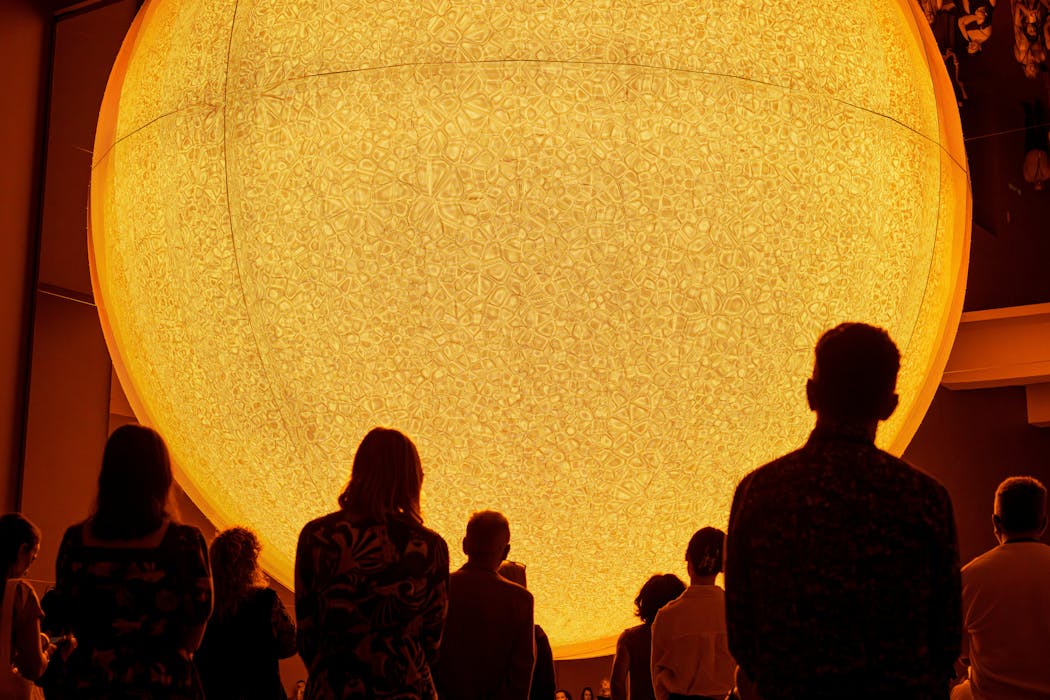
An enormous sun looms overhead in the gallery space. Somehow, it throbs and pulses with lights that render its surface active and alive. An austere rocky landscape inside another gallery reveals a riverbed and a narrow stream runs down the gentle slope towards the viewer.
Visitors explore, clamouring across the rocks and dipping their toes into the water to test the temperature. Outside, on a long table, visitors are invited to engage with hundreds of kilos of white Lego and build an imaginary cityscape.
Icelandic-Danish artist Olafur Eliasson is best known for producing large-scale, immersive installations. Most famously, he created a huge artificial sun for London’s Tate Modern in 2003. By recreating the experience of being outside, Eliasson established his reputation for pushing the boundaries of what is artistically possible.
In Presence, curator Geraldine Kirrihi Barlow has cleverly synthesised three decades of his diverse and multifaceted body of work that includes installation, photography and sculpture. The exhibition gives visitors a sense of the range of Eliasson’s preoccupations: spectatorship and the conditions of perception, the environment and climate change.
The long-term commitment of Queensland Art Gallery and Gallery of Modern Art (QAGOMA) to Eliasson’s practice is demonstrated through the return of much-loved installations including Riverbed (2014) and The cubic structural evolution project (2004), both part of the gallery’s permanent collection.

Developed specially for the exhibition is a spectacular new installation, also titled Presence. An enormous sun hovers in the corner of the gallery space. Eliasson uses mirrors to create the illusion of depth and space, further extending QAGOMA’s already generous ceiling heights. The “sun” is only a segment; the mirrors create the illusion that it is a sphere.
Amplifying the experience is the use of monofrequency light: the visitor is bathed in a yellow light, as the other colour frequencies are invisibilised, or edited out.
Facing the climate emergency
There is a deep art-historical impulse underpinning Eliasson’s work, and it is interesting to connect his work with 20th century artistic movements.
The reference points are many, ranging from the Californian Light and Space movement practitioners such as James Turrell and Robert Irwin and the Minimalist artists in the 1960s.
For these artists, the engagement with the viewer’s body is a core concern and the viewer was necessary to “complete” the work. Building on this idea, for Eliasson, the viewer becomes a vital co-producer in the work.
Eliasson’s work is often positioned as a harbinger alerting us to the threats of the climate emergency. In Ice Watch (2014) he harvested free-floating ice bergs and installed these in a circular formation outside the Tate Modern and the Place du Panthéon, Paris.

In The glacier melt series (1998/2019), Eliasson photographed glaciers in Iceland in 1998. Returning in 2019, 30 photographs placed side by side reveal the impact of 20 years of glacial retreat.
Eliasson’s glacier series is documentary in spirit and devoid of human activity. It is interesting to think about the points of connection with the history of conceptual photography and practitioners such as Ed Ruscha, who took photographs of gasoline stations in the early 1960s. German photographers Bernd and Hilla Becher systematically documented industrial architecture for over 40 years in a style that has been described as “deadpan” photography.
The viewer completes the work
Eliasson’s extensive use of mirrors and lenses provide another important visual link with the history of optical devices, photography and cinema.
Your timekeeping window (2022) is composed of 24 glass spheres embedded directly in the gallery wall. On close inspection, the spheres are projecting live activity directly outside QAGOMA’s entrance; the humans moving but upside down.

The work might be understood as a wry historical nod back to the camera obscura and the natural phenomenon whereby light passing through a small hole in a dark, enclosed interior will create an inverted image on the wall opposite. This has been known for at least 2,000 years and was discussed by philosophers such as Aristotle.
The analogy with the camera obscura underscores exactly what is at stake in Eliasson’s practice: representation itself. The rocks that form Riverbed are real rocks; the creek consists of real water. The installation, however, revels in its artificiality.
His frequent use of mirrors signals further interest in probing the tension between the natural and artificial. Like the camera obscura, mirrors also enjoy a long history in Western art history. In the Renaissance, the representation of a mirror in painting was a declaration of the painting’s status as a mimetic illusion.
Mirrors also have the capacity to fold the viewer into the work, reinforcing his commitment to co-production. The work is complete when the viewer becomes part of the work itself.
Behind the curtain
Eliasson delights in the “big reveal”, where he demonstrates to the viewer just how he has made the work.
Pluriverse assembly (2021) consists of constantly moving shapes and shadows projected onto an enormous, luminous screen. When the viewer walks to the other side of the screen, it is possible to view the series of rings, projectors and mirrors. He makes visible the mechanics driving the installation.

Other works investigate the intermingling between sound and light. Your truths (2025) is comprised of a series of fans placed on the gallery floor, gently blowing sheets of plastic.
The ambient soundscape produced by the scraping of the plastic on the floor is akin to the soothing sound of the ocean’s waves. We hear the work before we see it, as the sound bleeds into the surrounding gallery spaces.
Olafur Eliasson: Presence is at Brisbane’s QAGOMA until July 12.
This article is republished from The Conversation, a nonprofit, independent news organization bringing you facts and trustworthy analysis to help you make sense of our complex world. It was written by: Chari Larsson, Griffith University
Read more:
- ‘We need to rethink how we approach biodiversity’: an interview with IPCC ecologist and ‘refugee scientist’ Camille Parmesan
- Australia’s supercomputers are falling behind – and it’s hurting our ability to adapt to climate change
- Aging bridges are crumbling. Here’s how new technologies can help detect danger earlier
Chari Larsson does not work for, consult, own shares in or receive funding from any company or organisation that would benefit from this article, and has disclosed no relevant affiliations beyond their academic appointment.


 House Digest
 Raw Story
 The Babylon Bee
 America News
 The Rink Live
 Esquire
 The Daily Beast