

 The Conversation
An extensive government review of the Reserve Bank of Australia (RBA) in 2023 made 51 specific recommendations to enable “an RBA fit for the future”. But the narrow terms of reference confined the review to an economic lens.
The failure to investigate the effectiveness of monetary policy setting through a demographic lens has resulted in an RBA which is no longer fit for purpose.
The Reserve Bank has just one policy tool – the setting of official interest rates – to manage the economy and achieve its twin goals of:
- low and stable inflation
- full employment.
From a demographic perspective, the reality is that a large and growing proportion of the population is retired, with tax-free income thanks to superannuation and secure home ownership. They are immune to interest rate changes and may actually be fuelling inflation because their spending is not affected by interest rate rises.
A changing nation
After the second world war, Australia transformed economically and socially, driven by industrialisation, social movements and education reform, building on the foundations for a modern welfare state.
Demographic change was also underway. These transformations led to a sustained period of economic growth and wealth accumulation for many, but not all, Australians. The Reserve Bank of Australia was established by an act of parliament in 1959.
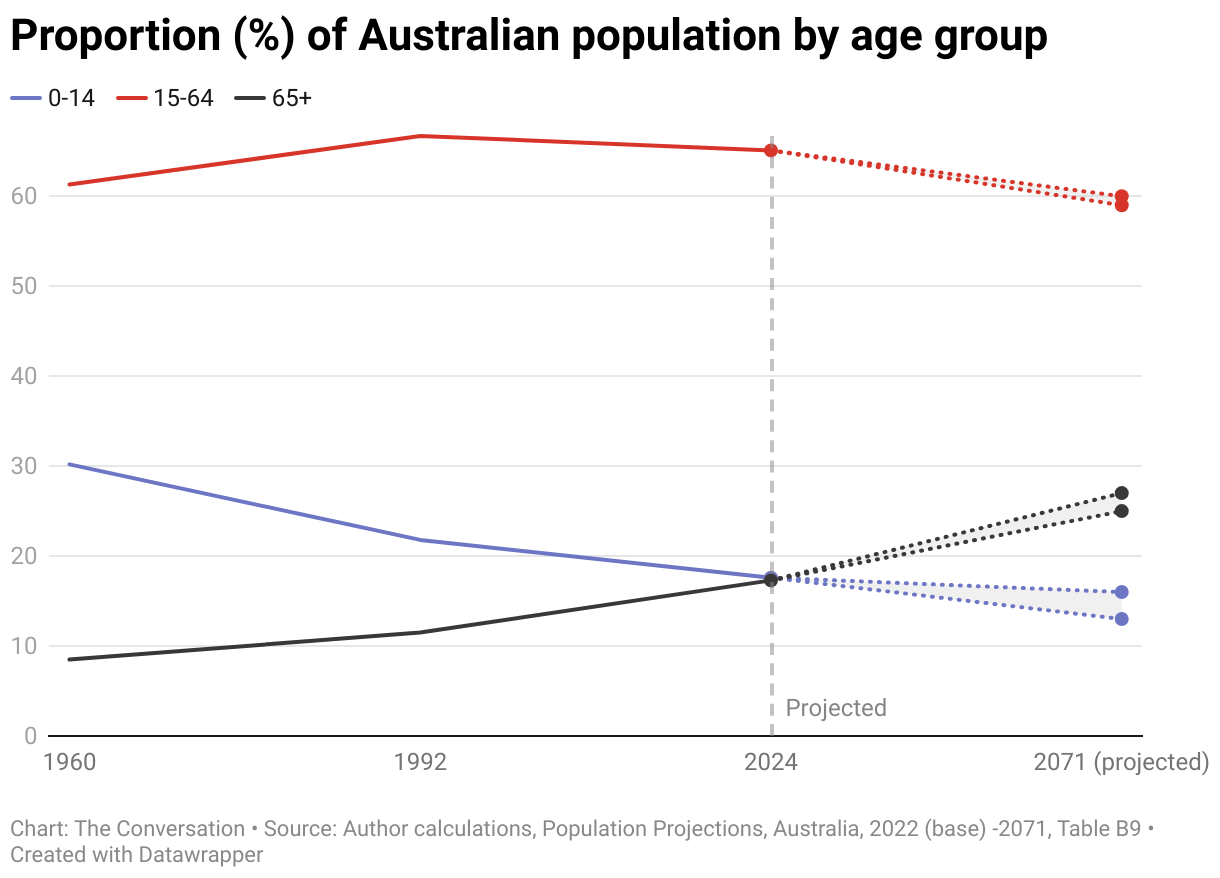
Australia was relatively young, economically and demographically. A larger proportion of the population was either school age or working age (15 to 64 years). Rising levels of education and workforce participation meant stronger economic growth, rising incomes and wealth accumulation.
In the post-war years, home ownership became the “great Australian dream”. The post-war baby boom continued until 1971. As a result, the working age population continued to increase until it peaked in 2010.
The great Australian dream
By the 1990s, a large proportion of the population held mortgages. So changes in official interest rates flowed straight through to households. The Reserve Bank’s main policy tool was highly effective.
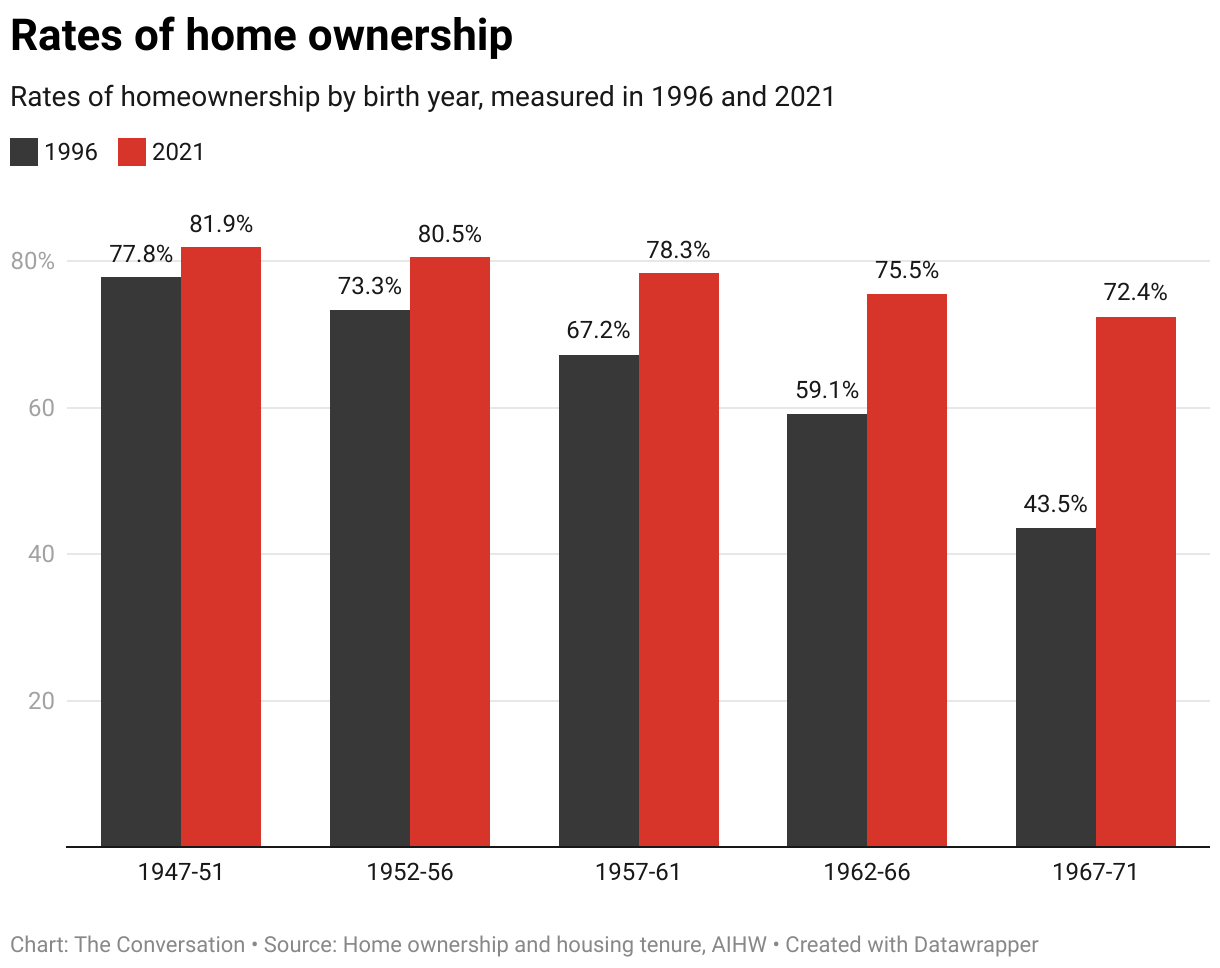
Over half (54.2%) of those born between 1947 and 1951 were home owners by the time they were 25 to 29 years old, increasing to 77.8% by the time they were 45 to 49 years at the 1996 census and 81.9% by 2021, aged 70 to 74 years.
Now, the post-war baby boomers are in retirement, or close to it. They have very high levels of home ownership, and so their spending patterns are mostly immune to interest rate changes.
When RBA moves had bite
High levels of home ownership and exposure to interest rates meant the RBA could meaningfully manage the economy by shaping household spending and business investment.
Critically, home ownership is one of three pillars of Australia’s retirement system, alongside compulsory superannuation introduced in the 1990s and the age pension.
Baby boomers reached their peak earnings capacity as the super system matured and also benefited from strong asset price growth. Those born before 1960 could access super pensions from age 55. Now in retirement phase, they receive guaranteed, tax-free income streams.
This tax-free income has further helped to insulate their spending from interest rate moves.
An ageing population
By 2024, the number of Australians aged 65 or older had increased by 437% since 1960 and 85.2% since 1992, according to calculations based on Australian Bureau of Statistics data.
And the majority are homeowners. According to the 2021 Census, 61.9% of Australians aged 60 or older owned their homes outright, 16.7% owned had a mortgage, and 13.8% rented. Based on life expectancy data, they can look forward to more than 20 years of future spending ahead, unaffected by moves in interest rates.
For the RBA, this really matters.
High rates of outright home ownership insulate people from mortgage rate fluctuations. Superannuation pensions provide stable income, regardless of movements in official interest rates.
In fact, for retirees with savings in term deposits or similar accounts, higher interest rates can actually boost discretionary spending, and thus feed through to inflation.
Immune to the RBA’s moves
Wealth accumulated by those born in the post-war era through home ownership and superannuation stimulates the economy. Spending by retirees on recreation, leisure and health, combined with wealth transfers, such as helping children with housing deposits, mortgage repayments or school fees, continues regardless of changes in interest rates.
The demographic reality is the growing over-65 population is not working, is financially and housing secure, and is immune to interest rate levers. The smaller, younger, working age families with mortgages are bearing the brunt of the RBA’s policy decisions. This risks widening inequity in Australia further.
As a result, the RBA is not meeting its overarching purpose, which is “to promote the economic prosperity and welfare of the Australian people”.
Other structural reforms should be considered. To achieve long-term economic prosperity and equity for all Australians, reform of tax settings around wealth, superannuation, housing and intergenerational transfers needs to be prioritised.
Without a demographic lens informing economic and social policy-making, Australia, and its governing institutions, risk failing future generations of students, workers and families.
This article is republished from The Conversation, a nonprofit, independent news organization bringing you facts and trustworthy analysis to help you make sense of our complex world. It was written by: Lisa Denny, University of Tasmania
Read more:
- The RBA is stuck in a tug-of-war, as it holds rates steady
- Illegal tobacco is messing up economic data. That won’t stop until it’s managed like alcohol
- How keeping down borrowing costs for mortgages and other loans is built into the Fed’s ‘dual mandate’
Lisa Denny is affiliated with Australian Population Association.


 AlterNet
 Reuters US Economy
 Raw Story
 People Crime
 Reuters US Top
 Butler Eagle