

 Reuters US Top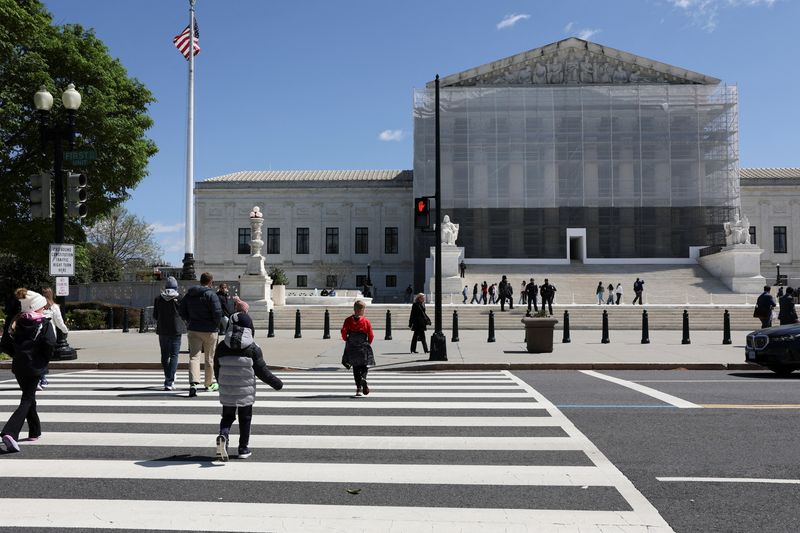
By John Kruzel
WASHINGTON, Dec 2 (Reuters) - U.S. Supreme Court justices appeared poised on Tuesday to side with the operator of Christian faith-based anti-abortion "crisis pregnancy centers" in New Jersey in a dispute stemming from the state attorney general's investigation into whether these facilities engage in deceptive practices.
During arguments in the case, a majority of the nine justices seemed inclined to revive a federal lawsuit brought by First Choice Women's Resource Centers challenging Democratic Attorney General Matthew Platkin's 2023 subpoena seeking information on the organization's donors and doctors.
First Choice, which has five locations in New Jersey, has appealed a lower court's determination that its federal lawsuit challenging Platkin's subpoena was premature in light of ongoing state court litigation over the matter.
The First Choice facilities seek to steer women away from having abortions. Platkin issued the subpoena as part of an investigation into whether First Choice deceived donors and potential clients into believing the facilities offered abortions and other reproductive healthcare services in violation of a state consumer-protection law and other statutes.
The question of whether the facilities acted deceptively was not before the Supreme Court. Rather, the case explored whether First Choice has the legal basis to bring a constitutional challenge to the subpoena in federal court, or if it must continue litigating the matter in state court, where the case is ongoing.
President Donald Trump's administration is backing First Choice in the case.
First Choice sued Platkin in New Jersey federal court in 2023, arguing that the subpoena violated its rights to free speech and free association under the U.S. Constitution's First Amendment. That suit was later thrown out by lower courts, prompting First Choice's appeal to the justices.
The subpoena sought First Choice's internal records, including the names of its doctors and donors.
Some of the justices seemed skeptical of the state's position that the subpoena by itself did not threaten to inflict a legal injury on First Choice because a state court's order was required to enforce the request for donor information.
"The broader common sense of the situation ... would seem to say, 'This is just kind of obvious that there's some kind of objective chill from a subpoena on speech,'" conservative Justice Brett Kavanaugh told Sundeep Iyer, a lawyer representing the state attorney general's office.
'AN ORDINARY PERSON'
Platkin's pursuit of donor information caused some donors to reconsider giving to the group, according to First Choice.
Liberal Justice Elena Kagan challenged Iyer to see the case from the perspective of a potential First Choice donor.
"I'm an ordinary person, and I think, 'Okay, these subpoenas, they're pretty regularly issued, and maybe this one will be denied, but, you know, maybe it won't.' And I'm fearful of that. I don't want my name being given," Kagan said. "So why isn't that enough?"
The Supreme Court, which has a 6-3 conservative majority, in 2022 overturned the 1973 Roe v. Wade ruling that had legalized abortion nationwide.
Following that decision, Platkin's office issued a consumer alert that warned the public that crisis pregnancy centers do not provide abortions and noted that such facilities "may also provide false or misleading information about abortion."
Crisis pregnancy centers provide services to pregnant women with the goal of dissuading them from having an abortion. Such centers often do not clearly advertise their anti-abortion stance, and abortion rights advocates have called them deceptive.
Days before the deadline for complying with the subpoena, First Choice sued Platkin in federal court.
First Choice is represented by the Alliance Defending Freedom, a conservative legal group that has brought other cases on behalf of anti-abortion plaintiffs.
Erin Hawley, the lawyer arguing for First Choice, told the justices that the subpoena was coercive, and that the consumer alert issued by Platkin's office demonstrated hostility to crisis pregnancy centers.
After First Choice's federal lawsuit, Platkin sought to enforce the subpoena in state court. A state judge in 2024 declined First Choice's request to quash the subpoena for the time being, ordering the parties to negotiate a narrower subpoena. The judge said that the constitutional issues could be litigated going forward.
The Supreme Court is expected to rule by the end of June.
(Reporting by John Kruzel; Additional reporting by Andrew Chung in New York; Editing by Will Dunham)

 Deseret News
 Seattle Medium
 America News
 The Atlantic
 Associated Press US News
 Reuters US Politics
 Local News in Florida
 AlterNet
 The Boston Globe Crime
 Raw Story
 CNN Politics
 The Hill