

 The Atlantic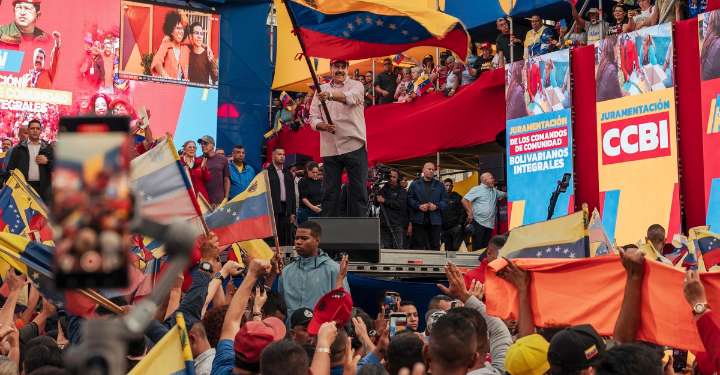
Since launching a military campaign in the Caribbean earlier this year, President Donald Trump has made clear what phase one of his plan looks like: killing alleged drug smugglers and pushing Venezuelan President Nicolás Maduro to leave office. The end goal—let’s call it phase three—is to work with a new government to gain access to the country’s oil and rare earth minerals. Phase two? That’s an open question.
Secretary of State Marco Rubio, who also serves as acting national security adviser, has taken the lead in planning for a variety of contingencies, several officials told us, although they said that the planning is restricted to a very small group of senior officials around the president and that they couldn’t provide any details. Other officials involved in Venezuela discussions told us that if there is any substantive planning being done, it was news to them, and that they had little understanding of what the administration intends to do in the event that Maduro is toppled. (The State Department didn’t respond to a request for comment.)
The opacity comes, in part, from Trump’s desire to avoid the pitfalls that came with previous U.S. attempts to plan for the unpredictable and often-chaotic outcomes of regime change in authoritarian nations. (See Iraq.) Trump, one official told us, prefers to take a “wait-and-see approach” before deciding his next move. But divisions within the administration over whether to go all the way in attempting to push Maduro from power also play a role.
Trump said in a Politico interview this week that Maduro’s “days are numbered.” But when it comes to accessing Venezuela’s oil and rare earths, would it be better to deal with a cornered and therefore pliant Maduro who stays in power, or to navigate the unpredictable terrain of a post-Maduro Venezuela, which could range from a new, Washington-friendly government to prolonged civic unrest?
One administration official we spoke with, who, like others, spoke on the condition of anonymity to discuss a sensitive subject, worried that going to war in Venezuela could create a failed state that would lead to a surge of migrants heading northward. Another official told us that even if Maduro were to leave willingly, things in Venezuela “will likely get worse before they get better. We need to be ready for that.”
Karoline Leavitt, the White House press secretary, told reporters on Thursday that “prolonged war is definitely not something this president is interested in. He’s been very clear about that.” But it’s less clear whether he has any actual plan to avoid it.
Trump’s Venezuela squeeze ostensibly isn’t about ousting Maduro at all, although he has clearly said that Maduro needs to go. His stated rationale for pressuring the leftist strongman is to stem the flow of drugs into the United States as a matter of national security, even though Venezuela is primarily a transit point for Colombian cocaine en route to Europe and plays a comparatively small role in the supply chain of illicit drugs to the U.S. Even some in the administration question whether the threat Maduro poses is in any way commensurate with the massive scale of the U.S. military response. Yet there is little doubt about Trump’s interest in ridding the Western Hemisphere of a socialist dictator closely allied with Cuba and Russia—and then accessing the treasures under Venezuelan soil.
“This is a shakedown—a financial shakedown,” another official said, one that is “being done primarily for profit.”
Venezuela is home to about 17 percent of the world’s known oil reserves, as well as a virtually untapped supply of crucial minerals. Because the Trump administration seeks to counter China’s global dominance in rare-earths production, it finds those mineral deposits particularly attractive.
“They have the critical minerals to fuel the 21st-century economy, and they are sitting on the world’s largest known reserves of oil, and they’re in bed with our strategic competitors,” Jimmy Story, who served as the U.S. ambassador to Venezuela from 2018 to 2023, told us. “All of that is true and Trump knows this to be true.”
So far, the U.S. has amassed a huge fleet in the Caribbean, led by the USS Gerald R. Ford aircraft carrier, as well as about 15,000 troops. As part of “Operation Southern Spear,” U.S. missiles have killed more than 80 alleged drug smugglers in more than 20 strikes. Trump has made the rare acknowledgement that he has authorized covert action by the CIA. On Wednesday, Trump told reporters that the U.S. had seized an oil tanker off the coast of Venezuela and hinted that more measures would be taken. The U.S. has started a “legal process” to take the oil from the tanker for domestic use, Leavitt said Thursday.
The U.S. also announced its latest round of sanctions against Venezuela Thursday, targeting a number of entities and individuals—among them, three of Maduro’s nephews—it says have been “propping up Maduro’s corrupt and illegitimate regime in Venezuela.”
Trump’s national-security team has been offering him options for land-based-missile targets for months, including some allegedly connected to drug cartels and the Venezuelan military. (The U.S. claims the two are intertwined.) Possible targets also include cartel operations in Colombia and in Mexico—where most of the drugs entering the U.S. come from—although the administration is unlikely to pursue those options for now, given the regional tensions they would spark.
The hope among some Trump advisers is that a combination of actions will cut some of the funding sources that Maduro relies on, leading to the collapse of his regime.
A Venezuelan official, who spoke on the condition of anonymity for fear of government retribution, told us that the situation in Caracas was tense. Maduro has told supporters that the U.S. is engaging in “psychological terrorism,” and he has taken extra security measures since the strikes on the drug boats began. But this Venezuelan official and several U.S. officials don’t believe that Maduro has moved any closer to handing over power. At roughly the time Trump convened his national-security team in the Oval Office last week, Maduro defiantly shimmied his hips in front of supporters at a political rally, in a style reminiscent of Trump’s own dance moves.
Almost a month before the 2000 presidential election, then-candidate George W. Bush, during a debate with Vice President Al Gore, scoffed at the use of U.S. forces to reshape other countries. “I don’t think our troops ought to be used for what’s called ‘nation building,’” he told the moderator, Jim Lehrer of PBS. “I think our troops ought to be used to fight and win war.”
Three years later, after 9/11 and on the eve of the Iraq invasion, Bush told the nation, “We will remain in Iraq as long as necessary, and not a day more.”
The U.S. never defined realistic strategic objectives or created a stable post-conflict Iraq, and it failed to convince the Iraqi people that its presence was intended to serve their interests. The war dragged on for almost two decades, costing the U.S. nearly $2 trillion, according to 2020 data from the Costs of War Project at Brown University.
In all of his campaigns, Trump has stressed the need to learn from the mistakes of the Bush years, saying that the U.S. should have “taken the oil” from Iraq and left. Now some of Trump’s supporters worry that the president is failing to heed those same lessons. “Of all those regime changes affected by the U.S. government, how many worked out well?” Tucker Carlson asked last month on his show. “It never works. But we’re doing it again, apparently.”
Some within the administration recognize the peril. “It’s like the invasion of Iraq all over again—just a kind of coalescing and a train that has left the station before the actual intelligence or prep has been considered,” one official told us.
Much of what happens next will depend on how Venezuela’s military reacts.
So far, there are no outward signs of the military turning on Maduro. Preparations are under way to defend against a U.S. attack, and Caracas may rely on guerilla fighters to bolster firepower against the U.S. The country’s arsenal is poorly maintained and its soldiers poorly trained. Still, Venezuelan troops could put up a fight. “If the guys with the guns stay with the regime, then it’s tough” to envision a smooth transition, Ryan Berg, a Latin America expert at the Center for Strategic and International Studies in Washington, told us.

 WEIS Radio
 Associated Press US News
 Associated Press Top News
 CNN
CNN Live 5 News Crime
 People Top Story
 Rolling Stone
 CNN Crime and Justice
 RadarOnline
 The Columbian Business